
Pressure washing job costing connects the customer’s payment with the labor, chemicals, travel, equipment and fees required to earn it. Revenue alone can make a busy week look successful while underpriced jobs consume the owner’s time and equipment. Close each completed job with actual costs and compare the result with the estimate.
This guide gives solo U.S. operators a practical closeout method. The examples are illustrative management calculations. Confirm tax, payroll and accounting treatment with qualified professionals and your own records.
What does pressure washing job costing measure?
Job costing assigns revenue and costs to one completed job. The result supports pricing and operational decisions when every number uses the same scope.
- Quoted price: the amount proposed before approved changes, discounts and tax.
- Net collected revenue: the amount earned and collected for the job after discounts and refunds, using one consistent tax treatment.
- Direct job cost: labor, material and other cost caused by the job under the chosen method.
- Allocated overhead: a consistent share of broader business costs assigned for management analysis.
- Job profit: net collected revenue minus included job costs.
- Job margin: job profit divided by net collected revenue.
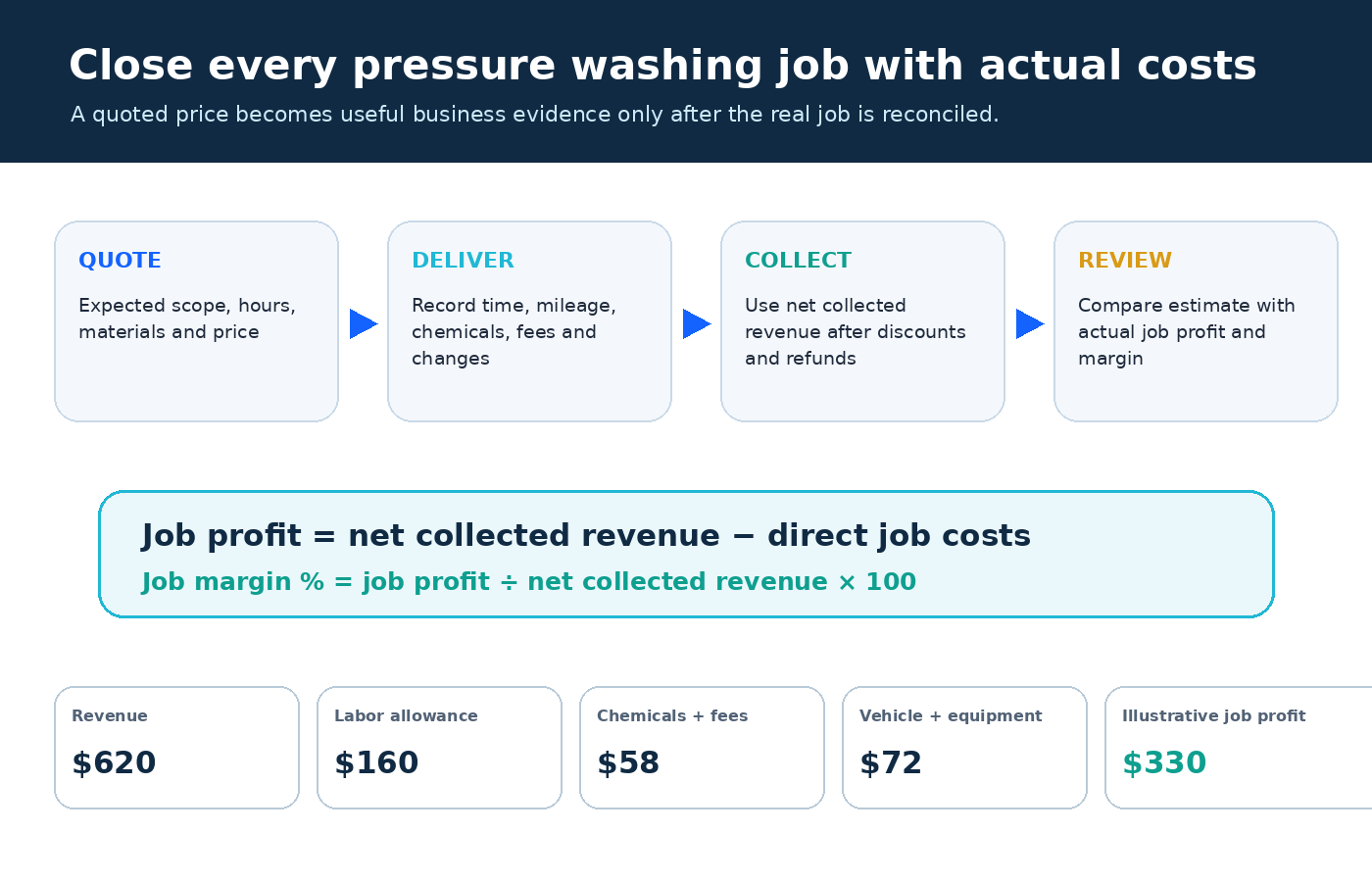
Job profit = net collected revenue − included job costs.
Job margin % = job profit ÷ net collected revenue × 100.
QuickBooks explains the basic relationship as sales income minus cost rates equals project profit and warns that general overhead should not be ignored. Keep the cost definition visible beside the result so a direct-cost margin is not mistaken for net business profit.
Which costs belong in a pressure washing job?
Use categories the owner can capture consistently. A highly detailed model that is never completed is less useful than a practical model closed after every job.
| Category | Possible job-level inputs | Control |
|---|---|---|
| Labor | Field hours, setup, cleanup, travel labor and approved rework | Use actual time and a defined cost rate |
| Chemicals and supplies | Detergent, treatment, fuel for equipment, tape, bags and disposable protection | Record quantity or a verified standard allowance |
| Vehicle | Business miles or an actual-cost allocation, tolls and parking | Do not mix methods in one report |
| Equipment | Rental, consumables, maintenance or replacement allocation | Use a documented method by service hour or job |
| Transaction | Card fee, financing fee, refund and customer-specific platform charge | Use processor records |
| External work | Subcontractor, disposal, permit or customer-specific rental | Attach the supplier cost to the job |
Overhead can be handled separately or allocated to jobs. Insurance, software, marketing, bookkeeping and administration still matter even when they do not change with one driveway. Choose one approach and apply it consistently across comparable reports.
Consistent pressure washing job costing depends on that written scope. If one month includes owner labor and the next omits it, the margin trend cannot support a pricing decision.
How should a solo owner record labor?
Owner labor is easy to omit because no wage may leave the bank account when the owner performs the work. For pricing and capacity analysis, the time still has value. Record an owner-labor allowance based on a sustainable hourly amount.
Owner labor allowance = job hours × internal owner cost rate.
Keep this management allowance separate from payroll and tax treatment. If the owner wants $40 per field hour for this analysis and the job uses four hours including setup and cleanup, record $160. A report that shows $490 of profit while treating four owner hours as free does not answer whether the job supported the owner’s income goal.
Track the complete job time
Include the activities the price must fund:
- Reviewing the scope and preparing the vehicle.
- Travel time when included in the service economics.
- Setup, protection and safety checks.
- Cleaning, treatment and approved changes.
- Breakdown, loading and site closeout.
- Job-specific customer communication or rework.
Sales and general administration can remain in overhead unless the business intentionally assigns them per job.
How do you track chemicals and supplies?
Choose units that can be recorded during normal work. For a frequently used chemical, calculate the cost per ounce, gallon or standard treatment batch from the current purchase invoice. Multiply by the amount used.
Chemical cost = quantity used × current unit cost.
If exact measurement creates too much burden, establish a standard allowance for a defined normal job and record exceptions. For example, a normal-condition driveway may use one standard treatment allowance, while heavy oil treatment is captured as a separate quantity and cost.
Reconcile the model against purchases. If the system reports 20 gallons used but 35 gallons were bought and little remains, leakage, waste, unrecorded jobs or an incorrect standard needs investigation.
Record water only when the business bears the cost
Many residential jobs use the customer’s supply. A business that transports water or pays a fill fee should record the actual cost and the extra vehicle or production burden. State customer water requirements in the quote where applicable.
How should mileage and equipment be assigned?
Use one internal vehicle method. The business can track actual fuel, maintenance, insurance, depreciation and operating cost, then allocate by business mile or job. A simpler management allowance can use a documented rate per business mile. Do not add both methods to the same job.
The IRS revised the optional standard business mileage rate to 76 cents per mile for eligible travel on or after July 1, 2026. That rate is a tax method and reimbursement benchmark. It is not proof that one operator’s van costs exactly 76 cents per mile. Confirm current IRS rules and professional advice before using any tax method.
Equipment cost also needs a consistent basis. Options include:
- Direct rental cost for the job.
- Maintenance and replacement allowance per operating hour.
- Standard allocation per comparable service.
- Separate treatment of major repairs and capital purchases in broader accounting.
The job report should explain which method was used. Otherwise, margins from different months may not be comparable.
Worked pressure washing job-cost and profit example
A pressure washing job costing record for a driveway and patio shows $620 of net collected revenue after an approved discount. The following figures are illustrative management inputs:
| Item | Calculation | Actual cost |
|---|---|---|
| Owner labor allowance | 4 hours × $40 | $160 |
| Chemicals and supplies | Recorded usage | $38 |
| Vehicle | 40 business miles × $0.76 internal allowance | $30.40 |
| Equipment allocation | Service-hour allowance | $42 |
| Payment fee | Processor record | $20 |
| Total included job cost | $290.40 |
Job profit is $620 − $290.40 = $329.60. Job margin is $329.60 ÷ $620 × 100 = 53.2 percent under this cost definition.
The result does not include every business expense. Insurance, marketing, software, bookkeeping, administration, tax and other overhead still need funding. If the business allocates $95 of overhead to this job, contribution after that allocation becomes $234.60, or 37.8 percent of net collected revenue.
Use the Artsians Profit Margin and Markup Calculator to verify the arithmetic, then save the cost scope with the result.
Compare the estimate with the actual job
The closeout should show where the plan changed:
| Measure | Estimated | Actual | Variance |
|---|---|---|---|
| Field hours | 3.25 | 4.00 | +0.75 |
| Chemicals and supplies | $24 | $38 | +$14 |
| Net collected revenue | $650 | $620 | −$30 |
| Included job cost | $245 | $290.40 | +$45.40 |
Write a cause beside material variances. In this illustration, the customer-approved discount reduced revenue, while extra treatment and setup increased time and chemical cost. The next comparable estimate can add a documented condition adjustment and improve the time allowance.
A single unusual job should not rewrite the whole rate card. Review a group of comparable jobs and distinguish random exceptions from a repeated pattern.
Which pressure washing profit reports help?
Build reports that lead to a decision:
- Job closeout: estimate, actual, variance, cause and action.
- Service summary: revenue, hours, job cost and margin by driveway, siding, deck or other service.
- Customer summary: repeat work, discount, payment delay and contribution by customer or property.
- Monthly capacity: field hours, travel, admin and unfilled capacity.
- Expense reconciliation: recorded job usage compared with purchases and processor fees.
Use net collected revenue consistently. A booked job, approved quote and sent invoice are different states. Reporting them as cash collected can distort decisions.
Protect privacy and access
Limit customer and payment data to what the operating record needs. Use role-appropriate access, secure devices, backups and retention rules. Do not place full payment credentials in the job-cost worksheet.
How does WashPro support job-cost review?
WashPro by Artsians is presented as an early-access focused workflow. The current demonstration uses fictional records and shows overview, jobs and customers, quote builder, expenses and reports concepts. Reports show completed revenue, recorded expenses and recorded margin within the sample workflow.
That margin is only as complete as the recorded costs and definitions. A missing owner-labor allowance, mileage or payment fee can make the result look stronger. Use the free WashPro demo to enter a fictional completed job and compare the output with a manual calculation.
The owner-supplied material describes a proposed $39 one-time price and no payment during early-access interest registration. Verify current release status, storage, backups, exports, accounting scope, support, updates, device compatibility and final terms before operational use.
Use a five-minute job closeout routine
- Confirm the final approved scope and net collected revenue.
- Enter actual labor or owner time.
- Enter chemical, supply, vehicle, equipment and transaction costs.
- Calculate job profit, margin and estimate-to-actual variance.
- Write one cause and one action when the variance is material.
Complete the closeout on the day of work or during the next scheduled administration block. Waiting until month-end makes time, material and exception details harder to reconstruct.
The goal is not perfect accounting inside the job record. Consistent pressure washing job costing creates an operating signal that improves estimates, rates, service mix and capacity decisions while reconciling to the formal books.
Frequently asked questions
How do I calculate profit on a pressure washing job?
Subtract the included actual job costs from net collected revenue. Net collected revenue should reflect discounts and refunds. Define whether labor, vehicle, equipment and payment fees are included. Divide job profit by net collected revenue to calculate the job margin percentage.
Which costs should be assigned to a pressure washing job?
Record labor or owner-time allowance, payroll burden where applicable, chemicals, water supplied by the business, fuel or mileage method, tolls, parking, payment fees, rentals, subcontractors, disposal, direct equipment allocation and customer-specific rework. Keep broader overhead visible in a separate allocation.
Should a solo owner count their own labor as a job cost?
Yes for pricing and operational analysis, because the owner’s field time has an economic value even when no payroll transaction occurs. Label it as an owner-labor allowance and keep it separate from tax or accounting treatment. Use a consistent rate and review it as income goals change.
Is the IRS mileage rate my actual vehicle cost?
No. The optional IRS standard mileage rate is a tax method and reimbursement benchmark, not proof of the vehicle’s economic cost for one business. For travel after July 1, 2026, the IRS announced 76 cents per business mile. Confirm current rules and choose a consistent internal method.
What is a good profit margin for pressure washing?
There is no universal percentage. The required margin depends on risk, overhead, owner compensation, equipment replacement, capacity, demand and alternatives. Compare consistent job margins by service and month. A high margin on a rarely booked service may contribute less than a lower margin on reliable work.
How do I track chemicals used on each job?
Use a standard unit such as ounces, gallons or treatment batches. Record the product, quantity and unit cost when practical. If exact measurement is too burdensome, establish a documented standard allowance for normal jobs and record exceptions. Reconcile purchases against usage periodically.
What is the difference between job profit and net business profit?
Job profit subtracts the costs assigned to that job from its net collected revenue. Net business profit also reflects broader expenses such as insurance, software, marketing, rent, administration, professional fees, taxes and owner compensation according to the reporting method. Label every figure by scope.
Can WashPro track pressure washing job profit?
The current early-access demonstration shows expenses and reports with completed revenue, recorded expenses and recorded margin using fictional data. The result is only as complete as the recorded costs. Verify the current scope, definitions, storage, exports and production readiness before using it as an accounting record.
Sources and review notes
- QuickBooks: Pay rates, cost rates and billable rates
- IRS Announcement 2026-11: Revised optional standard mileage rates
- Jobber: How to price pressure washing jobs
- Jobber: Pressure washing software and job costing
- Artsians: Profit Margin and Markup Calculator
- Artsians: WashPro early-access page
Product and source material was reviewed on November 24, 2026. Recheck IRS guidance, software scope, prices and terms before publication or operational use.
Comments