



AI marketing automation is worth it when a repeatable workflow releases useful staff capacity, improves measurable profit, or avoids a real cost—and those benefits exceed setup, software, review and maintenance costs. It is not worth it merely because a tool can generate more emails, posts or reports.
The decision therefore needs a baseline and a financial model. Measure how often the task occurs, how long it takes before and after automation, what human review remains, what the software really costs and whether any claimed revenue lift is incremental. This guide provides that calculation, worked scenarios and a practical pilot plan.
Is AI marketing automation worth it?
For many teams, the honest answer is sometimes. A high-volume, rules-based task with stable inputs and a clear reviewer can produce measurable value. A rare task that depends on judgment, confidential information or frequent exceptions may cost more to automate than to perform manually.
Use four tests before approving a purchase:
- Economic test: does conservative first-year value exceed all included costs?
- Operational test: will someone use the released capacity for useful work?
- Quality test: do accuracy, brand standards and customer outcomes remain acceptable?
- Risk test: are privacy, security, access and human-approval requirements satisfied?
If a workflow passes only the economic test, the business case is incomplete. A fast but unreliable lead-routing workflow can damage revenue. A content system that creates more drafts but requires extensive correction may move work rather than remove it.
AI automation is more likely to be worthwhile when
- the task happens frequently and follows documented steps;
- the input data is available, permitted and reasonably consistent;
- the output can be reviewed quickly against clear criteria;
- the manual process has measurable time, delay or error costs;
- the team knows how released time will be used; and
- the workflow can be stopped or reversed when quality falls.
It is less likely to be worthwhile when
- the process is undocumented or changes every week;
- task volume is too low to recover setup cost;
- most cases require individual judgment or negotiation;
- human review takes almost as long as the original task;
- several new subscriptions duplicate tools already available; or
- the project depends on an untested claim that automation will increase revenue.
What counts as AI marketing automation?
AI marketing automation combines a repeatable workflow with software that classifies, drafts, predicts, summarizes, routes or triggers part of the work. The automation may use generative AI, traditional rules, or both.
| Workflow | Possible automated step | Human responsibility |
|---|---|---|
| Lead capture | Standardize fields, remove obvious duplicates and route records. | Approve qualification rules and inspect exceptions. |
| Email follow-up | Trigger approved sequences and prepare personalized drafts. | Approve claims, permissions, offers and sensitive replies. |
| Content repurposing | Turn an approved article into draft channel variations. | Check facts, context, voice, rights and final publication. |
| Campaign reporting | Collect defined metrics and prepare a recurring summary. | Reconcile source data and interpret causes carefully. |
| Customer questions | Group de-identified questions into themes. | Review categorization and keep private cases out. |
| Creative testing | Generate bounded draft variations from an approved brief. | Select concepts, validate claims and approve the assets. |
A tool is not a workflow. A workflow specifies the approved input, the automated action, the reviewer, the exception route, the destination and the evidence that will be measured. The broader Artsians AI marketing strategy guide explains how these workflows connect to an objective and a 30-day plan.
Establish a baseline before buying software
Without a baseline, the team cannot distinguish genuine improvement from normal variation. Measure a representative sample before changing the process. Use the same task definition, period and quality standard in the before and after comparison.
Record the current workflow
- tasks completed per day, week or month;
- active working minutes per task;
- waiting time when speed affects customer experience;
- review, correction and exception time;
- error or rework rate;
- staff or contractor cost used for planning;
- current software and outsourced service costs; and
- the outcome connected to the task, such as qualified leads or completed campaigns.
Measure several real examples instead of asking for a rough memory. A task may feel like 15 minutes but take 28 minutes when searching, formatting, approvals and corrections are included.
Define quality before measuring speed
A faster process is not an improvement when it creates inaccurate claims, poor segmentation, broken links or unsuitable customer messages. Choose quality measures that fit the workflow, such as correction rate, routing accuracy, approved-draft rate, response time or qualified-lead rate.
How to calculate time saved by AI marketing automation
Use the after-time that remains once human review, corrections and exceptions are included.
Hours saved per month = tasks per month × (minutes before − minutes after) ÷ 60
Monthly labour value = hours saved × loaded hourly cost
Suppose a team processes 600 lead and reporting tasks each month. The current workflow takes six minutes per task. The automated workflow, including review, takes 2.5 minutes.
- Time reduction: 6 − 2.5 = 3.5 minutes per task.
- Monthly time released: 600 × 3.5 ÷ 60 = 35 hours.
- At a $30 loaded hourly cost: 35 × $30 = $1,050 monthly labour value.
Separate cash savings from capacity
Time released is not automatically money saved. Use one of these labels:
| Benefit type | Meaning | Evidence |
|---|---|---|
| Cash saving | A real expense, overtime payment or external fee is reduced. | Invoices, payroll or contracted-hours change. |
| Capacity created | The same team can complete more useful work. | Released hours are reassigned and output is recorded. |
| Service improvement | Customers receive faster or more consistent handling. | Response time, backlog, satisfaction or error measures improve. |
| Revenue contribution | The workflow produces incremental sales contribution. | Credible attribution or incrementality evidence exists. |
If released hours are not reassigned, the arithmetic can still describe potential capacity, but it should not be presented as realized profit. This is one of the most common reasons automation ROI is overstated.
Use external productivity findings as context, not a promise
OpenAI’s 2025 enterprise report states that surveyed ChatGPT Enterprise users attributed an average of 40–60 minutes saved per active day to AI use. Microsoft Research reported that workers given an integrated generative-AI tool spent three fewer hours on email per week, while the intent-to-treat estimate was 1.4 hours. These studies show that time effects can be material, but they do not predict the result of a particular marketing workflow, tool or team.

What does AI marketing automation really cost?
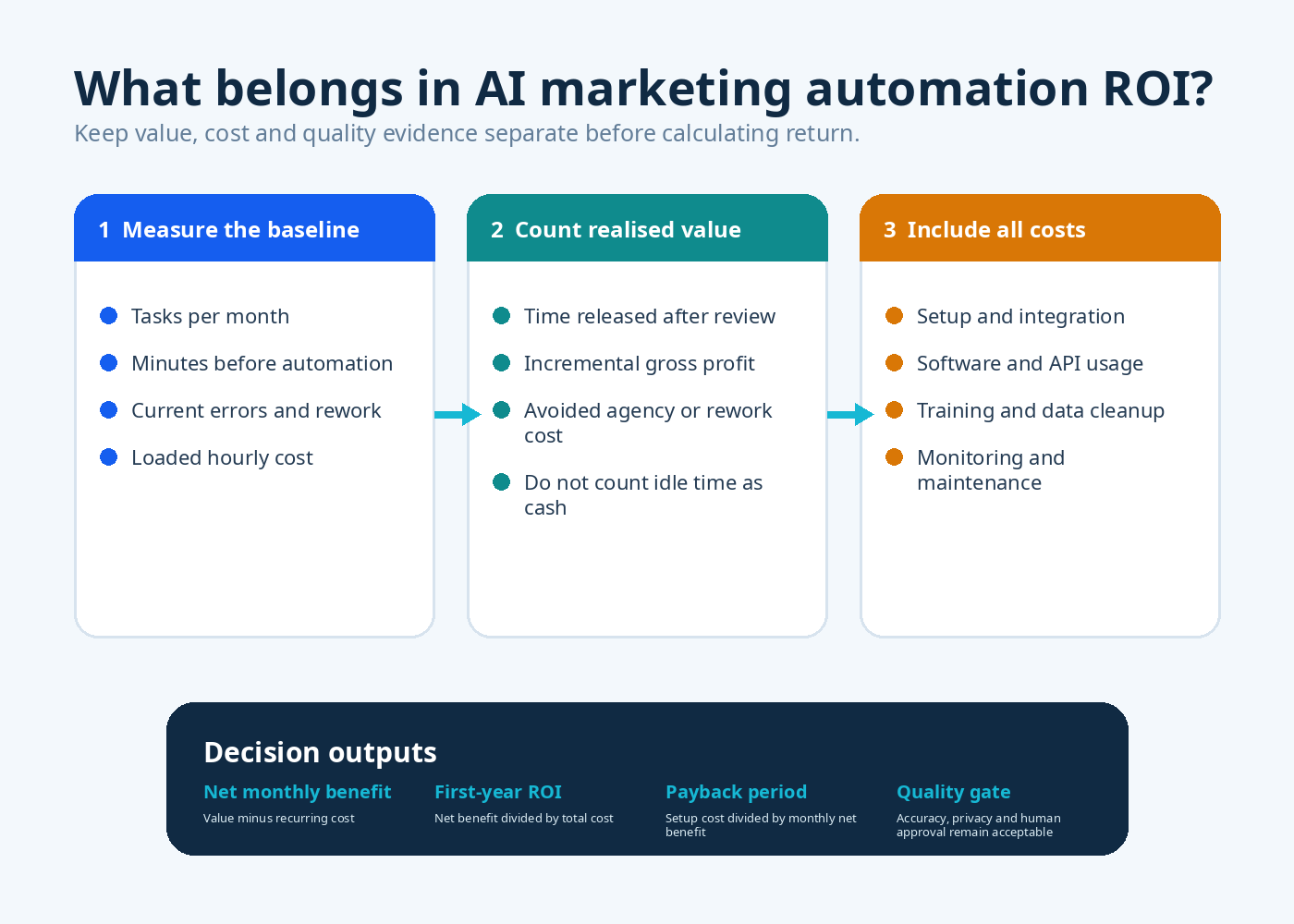
The monthly licence is only one part of the cost. Build a first-year total and a steady-state monthly total.
| Cost category | Examples | Timing |
|---|---|---|
| Process discovery | Mapping steps, owners, inputs, approval and exceptions. | Mostly one-time, repeated when scope changes. |
| Data preparation | Cleaning fields, permissions, naming and historical records. | Setup plus ongoing quality work. |
| Implementation | Configuration, integration, prompt or rule design and testing. | One-time with later change requests. |
| Software | Platform subscription, seats, API usage, storage and connected apps. | Monthly or usage-based. |
| Training and adoption | Documentation, staff training, supervision and change management. | Setup and periodic refresh. |
| Human review | Approval, fact checking, exception handling and corrections. | Recurring; include it in after-time. |
| Monitoring and maintenance | Checking failures, access, field changes and model behaviour. | Recurring. |
| Risk and compliance | Security, privacy, legal, audit and governance work. | Setup and recurring. |
| Exit and switching | Export, migration, retraining and workflow rebuilding. | Contingent but relevant to vendor choice. |
Do not use a promotional monthly price without checking the required tier, number of users, usage limits, tax and connected products. Where pricing changes with contacts, tasks, tokens or messages, model a low, base and high usage case.
How to calculate AI marketing automation ROI
Keep labour value and revenue value visible rather than combining them too early.
Step 1: calculate monthly benefit
Monthly total benefit = realised labour value + incremental gross profit + avoided costs
Incremental gross profit should use margin or contribution after relevant delivery costs. Gross revenue alone can make the result look stronger than the economics justify.
Step 2: calculate monthly net benefit
Monthly net benefit = monthly total benefit − software, API, maintenance and other recurring costs
Step 3: calculate first-year ROI
First-year total cost = one-time implementation cost + 12 × monthly recurring cost
First-year ROI = (first-year total benefit − first-year total cost) ÷ first-year total cost × 100
Step 4: calculate payback
Payback months = one-time implementation cost ÷ monthly net benefit
If monthly net benefit is zero or negative, simple payback is not reached. A positive percentage still does not remove quality, privacy or operational requirements.
Use the two Artsians calculators for different questions
The AI Automation Savings Calculator estimates hours saved, labour value, net monthly saving, first-year saving, ROI and payback from one recurring task model. Enter review time in the after-time and test several scenarios.
The Marketing ROI Calculator is useful when the automation supports attributed campaign revenue. It converts attributed revenue into gross profit using margin, then subtracts marketing and additional campaign costs. Do not enter the same labour saving in both calculators and then add the results again.
Worked example: content and lead operations automation
This is an illustrative calculation, not an Artsians client result, forecast or software price. A small marketing team wants to automate routine lead formatting, routing and weekly reporting.
| Input | Illustrative value |
|---|---|
| Tasks per month | 600 |
| Minutes before automation | 6 |
| Minutes after automation, including review | 2.5 |
| Loaded hourly cost | $30 |
| One-time setup and training | $3,000 |
| Software and usage cost | $180 per month |
| Revenue lift included | None in the base case |
Base-case calculation
- Time released: 600 × (6 − 2.5) ÷ 60 = 35 hours per month.
- Labour value: 35 × $30 = $1,050 per month.
- Net monthly benefit: $1,050 − $180 = $870.
- First-year benefit: $1,050 × 12 = $12,600.
- First-year total cost: $3,000 + ($180 × 12) = $5,160.
- First-year net benefit: $12,600 − $5,160 = $7,440.
- First-year ROI: $7,440 ÷ $5,160 × 100 = 144.2%.
- Simple payback: $3,000 ÷ $870 = about 3.4 months.
This result is worthwhile only if the 35 hours are genuinely released while quality remains acceptable. If the team still performs duplicate checks outside the measured workflow, the after-time is understated.
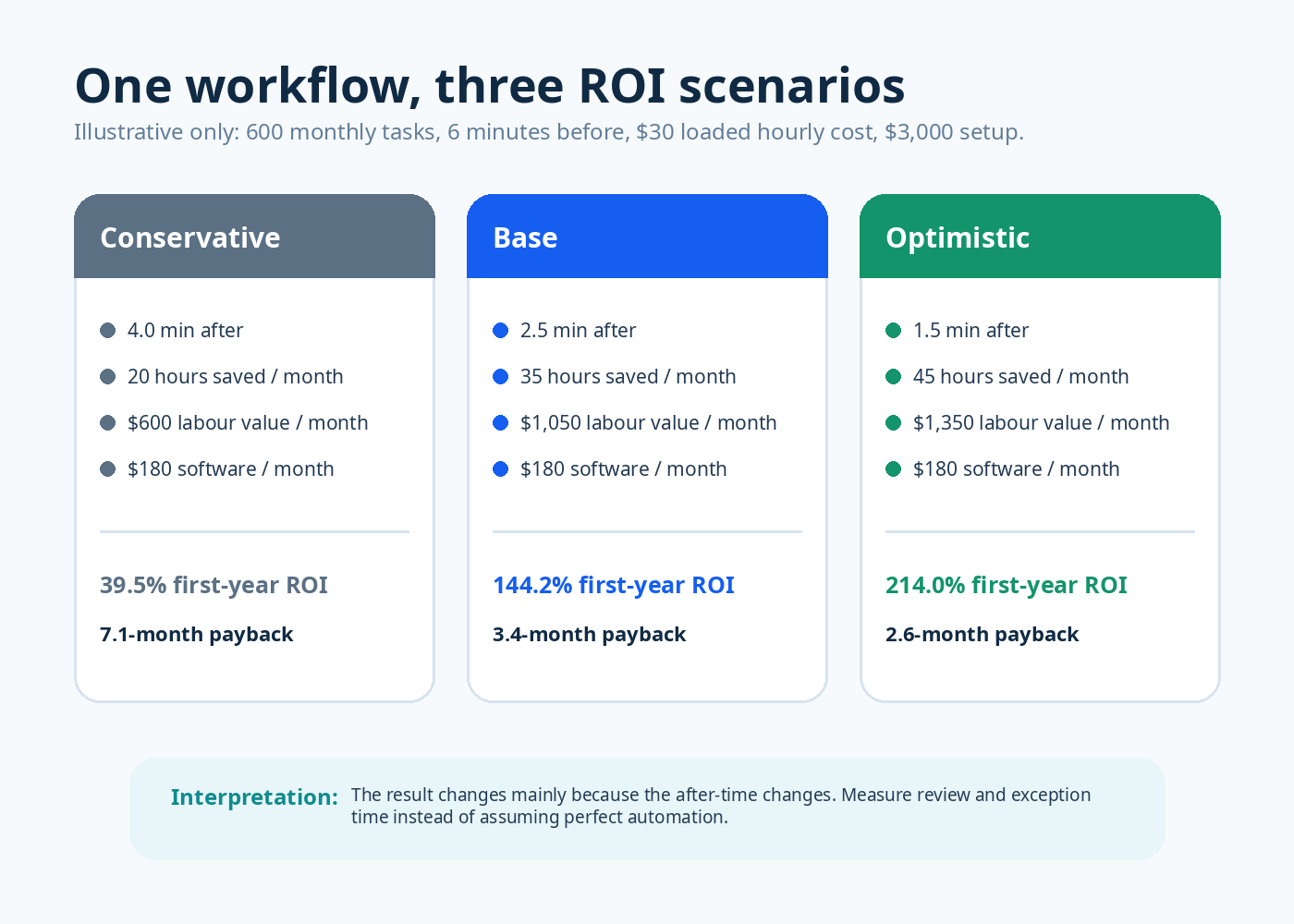
Conservative and optimistic scenarios
| Result | Conservative | Base | Optimistic |
|---|---|---|---|
| Minutes after | 4.0 | 2.5 | 1.5 |
| Hours saved monthly | 20 | 35 | 45 |
| Monthly labour value | $600 | $1,050 | $1,350 |
| Monthly net benefit | $420 | $870 | $1,170 |
| First-year ROI | 39.5% | 144.2% | 214.0% |
| Simple payback | 7.1 months | 3.4 months | 2.6 months |
When revenue lift is added
Suppose improved follow-up appears to add two customers per month, each with $250 contribution. That suggests $500 monthly incremental gross profit. Added to the base labour value, first-year benefit becomes $18,600 and modelled first-year ROI becomes about 260.5%.
However, do not add this amount merely because sales increased after implementation. Compare a credible baseline, account for seasonality and other campaign changes, and use consistent attribution. The labour-only case is usually the safer purchase decision; revenue lift can remain an upside scenario until evidence improves.
Example where automation is not worth it
A task occurs 100 times monthly and saves two minutes each time. At $25 per hour, the labour value is about $83 monthly. If the software costs $150 monthly before setup, recurring cost already exceeds modelled labour value. Unless the workflow produces another documented benefit, the team should simplify the design, use an existing tool or choose a higher-volume task.
Which marketing workflows should be automated first?
Prioritize frequency, stability, reviewability and low downside. The first workflow should teach the team how to measure and govern automation without placing a critical customer decision at risk.
| Candidate | Why it may work | Watch for |
|---|---|---|
| Weekly reporting preparation | Recurring inputs and a repeatable output. | Metric definitions, missing data and false causal explanations. |
| Approved-content repurposing | Source facts and voice already exist. | Context loss, repetition, rights and unchecked publication. |
| Lead-field standardization | High volume and clear formatting rules. | Incorrect merges, privacy and exception routing. |
| Internal campaign summaries | Easy human review before wider distribution. | Incomplete source data and invented conclusions. |
| Draft follow-up preparation | Can improve response consistency and speed. | Permissions, commitments, sensitive cases and final sender approval. |
For drafting workflows, the Artsians guide to using ChatGPT for digital marketing provides practical boundaries for research, content, customer communication and reporting.
A 30-day AI marketing automation ROI pilot
Do not automate the complete marketing operation at once. Use a bounded pilot that produces comparable evidence.
Days 1–5: measure and define
- Select one workflow and name its owner.
- Measure real task volume, time, errors and outcomes.
- Define acceptable output and mandatory human checks.
- Write the cost policy and benefit labels.
Days 6–10: build and test safely
- Use fictional, historical or appropriately sanitized inputs.
- Configure the minimum viable workflow.
- Test normal cases, missing fields and failure cases.
- Record setup time as implementation cost.
Days 11–20: run in shadow mode
Run the automated process beside the manual one without letting it make irreversible customer-facing decisions. Measure total after-time, corrections, exceptions and approval rate. Remove steps that create more review than value.
Days 21–30: use a limited live scope
Move only the approved portion into normal use. Monitor quality daily at first. At the end of the pilot, replace assumptions with observed volume, time and cost. Recalculate conservative, base and optimistic cases.
Decide to scale, revise or stop
- Scale: positive conservative economics, stable quality and available operational capacity.
- Revise: promising value but excessive review, exceptions or integration work.
- Stop: recurring cost exceeds credible benefit, or risk and quality cannot be controlled.
What current research suggests—and what it does not
The March 2026 CMO Survey reported that AI use had reached 24.2% of marketing activities, up from 13.1% in 2024. It also found that technology integration and data architecture remained a major barrier. Adoption therefore does not guarantee realized value; process, data and organizational capability still matter.
Research and vendor reports can help create a range, but they should not replace a workflow-level baseline. A reported industry productivity gain may include different tools, tasks, employee costs and review standards. Use external figures to test plausibility, then use your own pilot to approve spending.
Common AI marketing automation ROI mistakes
- Counting generated output: more drafts are activity, not financial return.
- Ignoring the after-time: review, corrections and exceptions remain work.
- Treating capacity as cash: label how released hours will be used.
- Using revenue instead of contribution: delivery costs can materially change ROI.
- Omitting implementation: mapping, cleanup, testing and training are real costs.
- Forgetting maintenance: workflows break when permissions, fields and tools change.
- Double-counting value: the same sale or saved hour should appear once.
- Assuming causation: a result after automation is not automatically caused by it.
- Buying overlapping software: use existing capabilities before adding another subscription.
- Scaling before quality stabilizes: increased volume can multiply errors.
AI marketing automation purchase checklist
| Area | Required evidence |
|---|---|
| Workflow | One repeatable process, owner, reviewer and exception route. |
| Baseline | Task volume, before-time, errors and outcome measured. |
| After-state | Review and correction time included. |
| Benefit | Cash saving, capacity, service or contribution labelled separately. |
| Cost | Setup, software, usage, training, review and maintenance included. |
| Risk | Data access, privacy, security, reliability and approval checked. |
| Economics | Conservative ROI and payback calculated with compatible units. |
| Pilot | Limited scope, quality threshold, stop rule and review date agreed. |
AI marketing automation ROI: frequently asked questions
How much does AI marketing automation cost?
There is no universal price. Include subscriptions, usage charges, integration, data cleanup, testing, training, human review, monitoring and maintenance. Check the required tier and limits rather than using a promotional entry price. Build a first-year total and a steady-state monthly total.
How much time can AI marketing automation save?
The result depends on the workflow, volume, input quality, exceptions and review. Measure the current task, run a pilot and calculate tasks multiplied by the reduction in minutes. External studies can provide context, but they cannot predict the savings for a specific business process.
Is time saved the same as money saved?
No. Time may create capacity, faster service or reduced backlog without reducing cash expense. Call it cash saving only when an actual expense, paid overtime, contractor fee or equivalent cost changes. Otherwise document how the released capacity is used.
What is a good ROI for marketing automation?
There is no universal percentage. Compare the return with the business’s alternatives, risk, cash constraints and required payback. A high modelled ROI based on uncertain revenue attribution may be weaker than a modest labour-only ROI supported by measured time savings.
How long should AI automation take to pay back?
Calculate setup cost divided by conservative monthly net benefit. The acceptable period depends on cash flow, technology risk and how long the workflow is expected to remain useful. If monthly net benefit is zero or negative, simple payback is not reached.
Can a small business benefit from AI marketing automation?
Yes, when it selects a frequent, low-risk workflow and avoids an oversized tool stack. Reporting preparation, approved-content repurposing and lead-field standardization may be useful pilots. Low task volume or expensive required tiers can make the same project uneconomic.
Should revenue lift be included in automation ROI?
Include incremental gross profit only when attribution is credible. Keep it separate from labour value and run a labour-only case first. Do not credit the automation for every sale that occurred after implementation or use gross revenue without considering margin.
Does a positive ROI mean the automation is safe?
No. Financial modelling does not assess privacy, security, legal, reliability, bias or human-impact requirements. Apply appropriate governance, testing, access control and human oversight. Stop the workflow when quality or risk exceeds the agreed threshold.
Make the decision with measured inputs
AI marketing automation is worth it when useful, realized value exceeds total cost while quality and risk remain acceptable. Begin with one workflow, measure the baseline, include human review in the after-time and separate capacity from cash savings. Then calculate first-year ROI and payback with conservative assumptions.
Use the AI Automation Savings Calculator for task-level time and cost scenarios. Use the Marketing ROI Calculator when credible campaign contribution is available. After a limited pilot, replace estimates with observed evidence and scale only the workflow that earns its place.
Sources and further reading
Continue planning


