


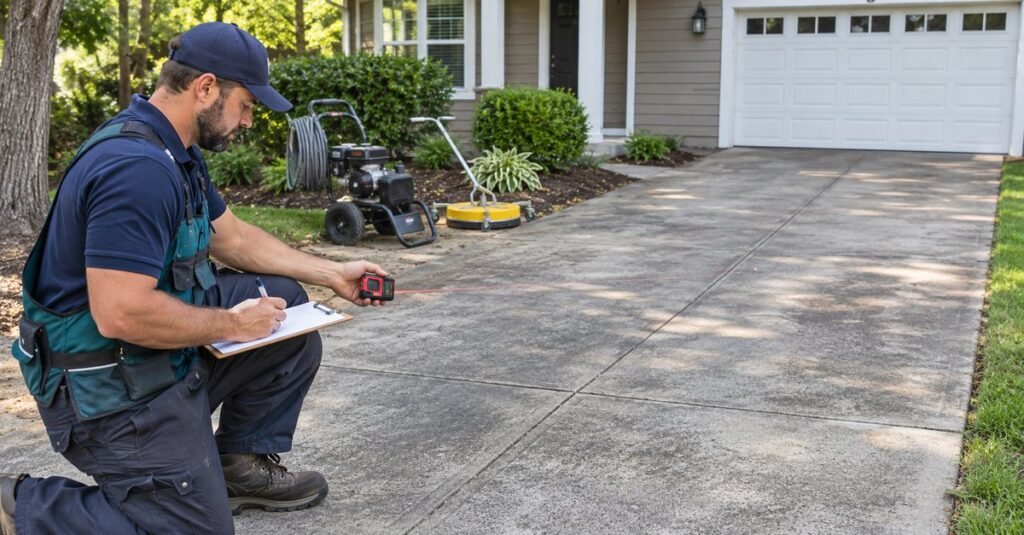
A reliable pressure washing estimate by square footage starts with the actual cleanable area, then adjusts for surface type, condition, access, treatment, minimum charge and other job-specific work. Multiplying one rough property size by one universal rate is fast, but it can produce a precise-looking number for the wrong scope.
This guide explains a repeatable measurement and pricing workflow for solo U.S. operators. Every rate and dollar figure is illustrative. Use your production records, costs, local market and applicable rules before sending a customer price.
When should a pressure washing estimate use square footage?
Square-foot pricing works best when area strongly predicts the amount of work and the operator has a stable method for similar surfaces. Driveways, patios and other flatwork often fit because length and width can be measured, production can be compared across completed jobs and the service scope can be described clearly.
Area is less useful when time is driven by another factor. A small surface with severe oil staining, difficult drainage or blocked access may take longer than a much larger open slab. House siding, roofs, decks and fences may need their own measurement and pricing rules because height, pitch, material, fragility and access change the method.
Jobber’s pressure-washing pricing guide describes square-foot, hourly and flat-rate approaches. It recommends measuring each surface and adding the areas for multi-surface work. The practical choice is the method that predicts your actual labor, material, overhead and risk most consistently.
Use one method for the estimate and a second check
A square-foot calculation should still pass a time-and-cost check. If 960 square feet at the chosen rate produces $211 but the expected travel, setup, treatment and cleaning require four hours, the rate or adjustment rules need review. The second check catches work that sits outside the normal production pattern.
How do you measure square footage for pressure washing?
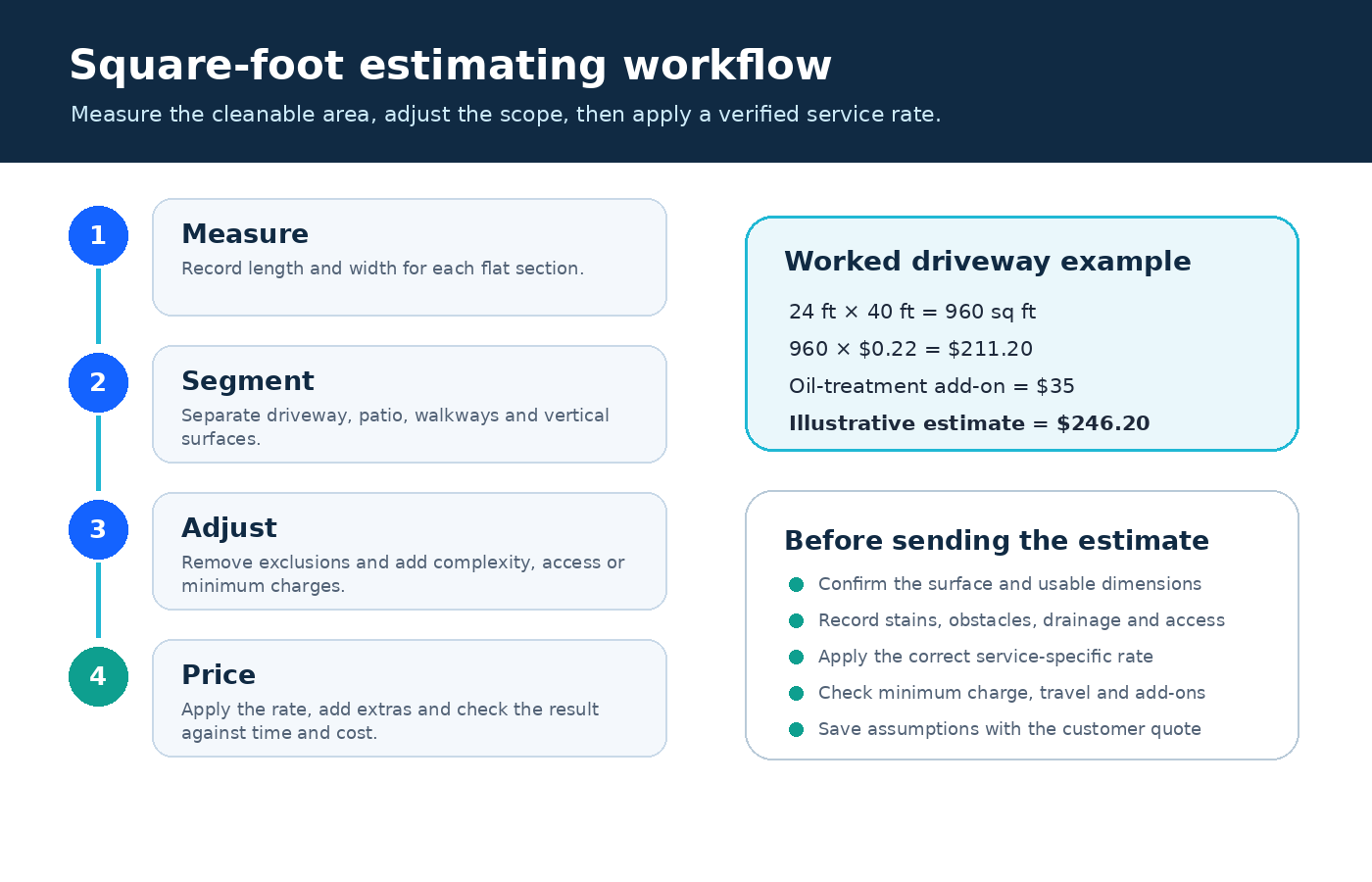
For a rectangle, multiply length by width. Measure in the same unit and convert only once. A driveway measuring 24 feet by 40 feet contains 960 square feet.
Square footage = length × width.
Divide irregular areas into simple shapes:
- Rectangle: length × width.
- Triangle: base × height ÷ 2.
- Circle: π × radius² when a circular section matters.
- Composite area: calculate each section, then add the results.
Subtract large areas that will not be cleaned, such as a planted island or a permanent structure. Small fixtures can remain inside the measured area when the normal rate already covers working around them. Consistency matters more than false precision.
Save the measurement evidence
Keep a sketch, measurement notes or an approved annotated image with the estimate. Label each surface and exclusion. The record helps the technician deliver the quoted scope and supports a clear change conversation if the customer later adds another walkway or patio.

Use a different rate rule for each service surface
One square foot of open concrete is not equivalent to one square foot of delicate siding or steep roof. Each service should have a defined production method, normal condition range and rate basis.
| Surface | Useful measurement | Common adjustment questions |
|---|---|---|
| Driveway or patio | Flat cleanable area | Oil, rust, slope, drainage, edges and obstacles |
| Walkways | Length × average width | Narrow access, edging and disconnected sections |
| House siding | Wall area or a consistent house-size method | Stories, material, oxidation, access and landscaping |
| Deck | Floor area plus separately measured stairs or railings | Wood condition, coating, furniture and fragile areas |
| Fence | Length × height, one or both sides | Material, vegetation, access and number of faces |
| Roof | Verified roof area and pitch method | Pitch, material, access, safety and treatment limits |
ResponsiBid’s current pressure-washing page describes configurable pricing by house size, stories, square footage, roof pitch and condition. That illustrates why a reliable quote system needs service-specific variables rather than one rate for every property.
How should condition, access and risk change the estimate?
Use named adjustments with evidence. A condition multiplier can be convenient, but it should represent expected extra work. A better record describes the cause:
- Heavy organic growth or embedded dirt.
- Oil, rust, efflorescence or other specialty treatment.
- Steep slope, poor drainage or water-control requirements.
- Restricted vehicle access or a long hose run.
- Moving customer items, protecting plants or containing runoff.
- Additional setup, height, safety or delicate-surface requirements.
State outcome limits for stains. Cleaning can improve a surface without restoring it to a new appearance. Do not guarantee removal when the result depends on the material, depth, age or prior damage.
Avoid double counting
If the base service rate already includes ordinary setup and light organic growth, do not add them again. Write the normal-scope definition beside the rate. Add only the work outside that definition.
How do you set the square-foot rate?
Start with completed jobs, not a national price list. For a group of similar jobs, record cleanable area, field time, travel and setup, chemical use, payment fees, direct equipment or vehicle allocation and the net amount collected.
Calculate the effective production rate and contribution:
- Production rate = cleanable square feet ÷ field hours.
- Collected rate per square foot = net collected revenue ÷ cleanable square feet.
- Direct contribution = net collected revenue − included job costs.
Group only comparable surfaces and methods. Ten open-driveway jobs can support a driveway rate. They should not be averaged with roof treatments or two-story siding.
Set a minimum charge
Small jobs still require inquiry handling, route time, setup, safety checks, breakdown and payment administration. Calculate the smallest job that covers those requirements and the intended profit. Apply the minimum when area × rate falls below it.
Review the rate after material cost, fuel, insurance, equipment, wage or process changes. A rate that worked last year may no longer cover the same job.
Worked pressure washing estimate for a driveway
A rectangular driveway measures 24 feet by 40 feet. The operator has a verified illustrative base rate of $0.22 per square foot for normal-condition concrete in the local service area.
- Area: 24 × 40 = 960 square feet.
- Base service: 960 × $0.22 = $211.20.
- Approved oil-treatment add-on: $35.
- Illustrative estimate before tax: $246.20.
The price should also pass the business’s minimum and expected-cost check. Suppose the operator expects 2.25 field hours, $18 of chemicals and supplies, $22 of vehicle and equipment allocation, and $70 of other included direct cost. The $246.20 price leaves $136.20 before broader overhead and tax under that assumed cost definition.
This example does not recommend a market rate. Jobber publishes broad pricing ranges, but location, service, condition and business economics vary. Use external ranges only as a reasonableness check after building the rate from real records.
How should remote and on-site estimates work?
A remote estimate can save travel when the surface is visible and the information is current. Ask for the address, service areas, clear photos, approximate dimensions, access notes, water availability, known stains and the customer’s requested timing.
Remote imagery cannot reliably show every slope, stain, fragile area, blocked gate or recent property change. Define the estimate status:
- Firm quote: scope and conditions are sufficiently verified and the business accepts the defined risk.
- Provisional estimate: price depends on an on-site verification before work or booking.
- Range: material uncertainty remains and the customer understands the variables.
Do not surprise the customer with an unexplained increase at arrival. Record what can change the price and obtain approval before added work.
Turn the calculation into a clear customer quote
The customer needs a defined outcome and scope, not a page of internal formulas. Show:
- Property and service address.
- Specific surfaces and approximate measured area.
- Included treatment, setup and protection steps.
- Named exclusions and stain-result limitations.
- Price, tax treatment, deposit or payment terms and quote expiry.
- Customer responsibilities for access, water and movable items.
- Change-approval process and cancellation or weather terms.
Keep the measurement record attached internally. If the customer adds a surface, revise the scope and preserve the earlier version rather than editing the total with no explanation.
Test the pressure washing estimate workflow in WashPro
WashPro by Artsians is presented as an early-access workflow for pressure washing estimates, jobs, expenses and reports. The current owner-supplied material shows a quote builder that accepts a rate per square foot, square footage and extra charges. It also describes a proposed $39 one-time price and no payment during interest registration.
Use the free Pressure Washing Estimate Calculator to test arithmetic, or open the WashPro interactive demo with fictional data. Neither tool measures the property or selects the correct local rate.
Before operational use, verify the current release status, storage, backups, exports, device compatibility, tax behavior, support and final terms. Compare the tool’s result with a manually checked example.
Common square-foot estimating mistakes
- Using total lot or building area instead of the cleanable surface.
- Applying one rate to different surfaces and service methods.
- Ignoring travel, setup, minimum charge and payment fees.
- Adding vague multipliers with no documented reason.
- Failing to record exclusions, stains and customer-added scope.
- Quoting from remote imagery without a verification rule.
- Copying competitors without checking production and cost.
- Never comparing estimated measurements and hours with actuals.
The estimate becomes more accurate through disciplined closeout. Record actual area, time, material and outcome. Then adjust the rate or scope rules for the next comparable job.
Frequently asked questions
How do I estimate a pressure washing job by square footage?
Measure each cleanable surface, calculate its area, subtract major exclusions and apply the verified rate for that surface and condition. Add minimum charges, access difficulty, treatment, water or equipment requirements and travel where applicable. Save the measurements and assumptions with the estimate.
What is the formula for square footage?
For a rectangle, multiply length by width. Divide irregular areas into measurable shapes, calculate each area and add the results. For a triangle, multiply base by height and divide by two. Measure sloped or vertical work according to the actual surface being cleaned.
Should every pressure washing service use the same square-foot rate?
No. Concrete, siding, decks, fences and roofs differ in method, chemical use, production rate, access, risk and equipment. Maintain service-specific rates and adjustment rules. A universal rate can underprice difficult work and overprice simple work even when the areas are identical.
How do I estimate an irregular driveway?
Break the driveway into rectangles, triangles or other simple sections. Measure each section, calculate the area and add them. Exclude large islands or uncleaned zones. Record a sketch or annotated photo so the customer and technician can understand the measured scope.
Should I quote from satellite measurements?
Remote measurements can support an initial estimate when the imagery is current and the surface is visible. Verify access, condition, slope, obstacles and actual cleanable area before guaranteeing the price. State whether the quote is provisional and what conditions can trigger an approved change.
How should stains and heavy buildup affect the estimate?
Treat condition as a documented adjustment rather than quietly changing the base rate. Record the affected area, likely method, extra chemical, dwell time, agitation, repeat passes and outcome limits. Explain that some stains may improve without disappearing completely.
What minimum charge should a pressure washing business use?
There is no universal minimum. Calculate the cost of travel, setup, safety checks, equipment preparation, work, cleanup, administration and required profit for the smallest accepted job. Compare that result with local demand, then publish and apply one consistent minimum rule.
Can WashPro measure a property automatically?
The current WashPro early-access material demonstrates an area-based quote workflow with rates, square footage and extra charges. It does not measure a property or determine the correct local rate. Verify the current demo, storage, terms, production scope and calculation behavior before using it operationally.
Sources and review notes
- Jobber: How to price pressure washing jobs
- ResponsiBid: Pressure washing quoting workflow
- Artsians: WashPro early-access page
- Artsians: WashPro estimating workflow
- Artsians: Pressure Washing Estimate Calculator
Product and source material was reviewed on November 24, 2026. Recheck changing product scope, prices, terms and local requirements before publication or operational use.


