



A Meta ads budget for small businesses should not begin with a universal figure such as $10 or $50 per day. It should begin with the number of customers you need, the share of leads that normally qualify, the sales conversion rate and the most you can afford to spend to acquire a customer.
That reverse calculation turns ad spend into a business decision. It also shows whether your target is realistic before a campaign starts. This guide provides the formulas, planning ranges, worked examples and review rules needed to build that decision.
How much should a small business spend on Meta ads?
Therefore, spend enough to test a clear business question, but not so much that a failed assumption damages cash flow. The useful answer is a range rather than one daily amount.
Next, start with three figures:
- Minimum test: the smallest total that can produce a useful lead sample.
- Base plan: the amount supported by current CPL and conversion assumptions.
- Maximum exposure: the amount you can lose or reallocate without harming essential operations.
A reliable Meta ads budget for small businesses is therefore tied to decision quality, not a fashionable daily figure. A $5 daily campaign may technically deliver in some accounts, objectives and markets. However, it may take too long to produce enough leads for a useful decision. Meanwhile, $100 daily can be wasteful if the business cannot answer, qualify or serve the resulting inquiries.
Use a total budget before choosing a daily budget
First, estimate the total media spend needed for the campaign. Next, divide it by the number of active days. This order keeps the daily figure connected to a lead or customer target.
For instance, a $1,500 test across 30 active days averages $50 daily. A $1,500 test across 15 days averages $100 daily. Both plans have the same total exposure, although delivery pace and the time available for review differ.
Build a Meta ads budget for small businesses from customer economics
A cheap lead is not automatically a profitable lead. Instead, start with the value and cost of a new customer. Then decide what customer acquisition cost the business can support.
Define an affordable customer acquisition cost
Instead, use contribution rather than revenue alone. Contribution is the amount left after the variable costs needed to deliver the product or service. It may need to cover acquisition cost, overhead, refunds, risk and profit.
For example, a service sells for $500 and costs $200 to deliver. Its first-sale contribution is $300. Spending the full $300 to acquire a customer would leave nothing from that sale for overhead or profit. Therefore, the business must choose a lower allowable acquisition cost or justify the spend with reliable repeat-customer value.
The Artsians Customer Acquisition Cost Calculator can help separate paid-media cost from a broader, all-in acquisition view.
Separate raw leads, qualified leads and customers
However, one denominator cannot describe the complete funnel. A raw form submission may be duplicated, unreachable or outside the service area. A qualified lead meets the documented criteria. A customer completes the defined purchase.
| Stage | Definition | Cost formula |
|---|---|---|
| Raw lead | Any captured inquiry before validation. | Spend ÷ raw leads |
| Valid lead | A real, reachable contact within scope. | Spend ÷ valid leads |
| Qualified lead | A valid lead meeting the agreed buying criteria. | Spend ÷ qualified leads |
| Appointment | A qualified lead who books or attends the next step. | Spend ÷ appointments |
| Customer | A person who completes the defined purchase. | Spend ÷ new customers |
This distinction matters because a campaign can show a low raw CPL while producing an expensive qualified lead or customer.
How to calculate a Meta ads budget for small businesses
First, use reverse funnel math when you have a customer target. Each conversion rate must use the same definition and a compatible reporting period.

Formula 1: budget from a raw-lead target
Media budget = target raw leads × expected raw CPL
For example, if the target is 80 raw leads and expected CPL is $25, the media budget scenario is $2,000.
Formula 2: budget from a qualified-lead target
Target raw leads = target qualified leads ÷ qualification rate
Media budget = target raw leads × expected raw CPL
Suppose the business needs 40 qualified leads, while 50% of raw leads usually qualify. It needs an estimated 80 raw leads. At $25 raw CPL, media spend becomes $2,000.
Formula 3: budget from a customer target
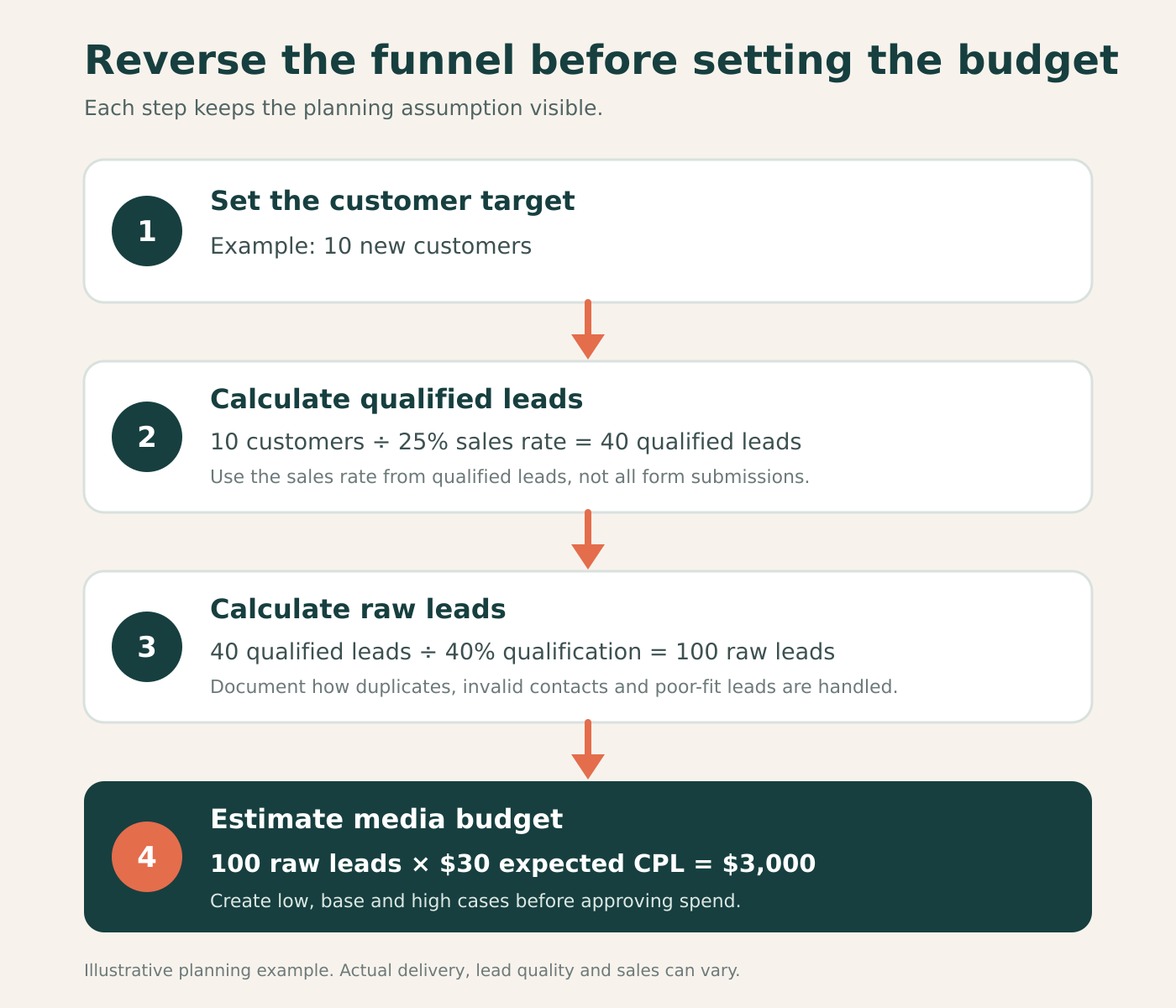
Target raw leads = target customers ÷ (qualification rate × qualified-lead sales rate)
Media budget = target raw leads × expected raw CPL
For instance, a business wants 10 customers. It expects 40% of raw leads to qualify and 25% of qualified leads to buy. The raw-lead-to-customer rate is 10%. Therefore, it needs about 100 raw leads. At $30 CPL, the media budget scenario is $3,000.
Formula 4: maximum affordable raw CPL
Maximum raw CPL = allowable customer acquisition cost × raw-lead-to-customer rate
If allowable media-only acquisition cost is $300 and 10% of raw leads become customers, the maximum affordable raw CPL is $30. However, the model should also include failed months, refunds and conversion uncertainty before setting a firm cap.
Use the Artsians Meta ads budget calculator
The Meta Ads Budget and Lead Calculator supports two planning directions. You can estimate funding from a lead target, or estimate lead volume from an available budget. It also lets you add a testing buffer to a target-based plan.
- Choose one currency and use it throughout the scenario.
- Enter a recent expected CPL from a comparable campaign.
- Add target leads or available budget.
- Set the campaign duration.
- Create low, base and high CPL scenarios.
- Apply your qualification and sales rates outside the raw-lead estimate.
However, the tool performs arithmetic; it does not predict Meta delivery. Save the assumptions, calculation date, lead definition and source of the CPL so the result can be reproduced later.
How to use 2026 Meta ads benchmarks without copying them blindly
When modelling a Meta ads budget for small businesses, external benchmarks can create a starting range when no account history exists. However, they should not become a promise or a permanent target.
WordStream analysed 452 US leads-objective campaigns running from April 2025 through June 2026. It reported a median CPL of $27.39 across the sample. Selected medians included $12.30 for career and employment, $26.31 for education and instruction, $39.25 for furniture and $61.56 for dentists and dental services.
Those figures reflect a specific US sample, campaign objective and period. Your country, offer, audience, form, creative, season and qualification rule may produce a very different result. In addition, the lowest CPL is not necessarily the best business outcome.
Turn Meta ads budget benchmarks into a cautious planning range
Instead of entering one borrowed CPL, create three cases. For example, a business might test $20, $25 and $35 only when those values are reasonable for its context. Then it should replace them with observed data as soon as a comparable campaign has enough valid outcomes.
Use the Artsians CPL Calculator to record raw, valid and qualified CPL separately. This prevents a low-quality lead source from appearing more efficient than it is.
Meta ads budget for small businesses: worked scenarios
Importantly, the following examples are planning models, not case studies or promised results. Every scenario assumes a fixed media budget of $1,500 and a 30-day period.

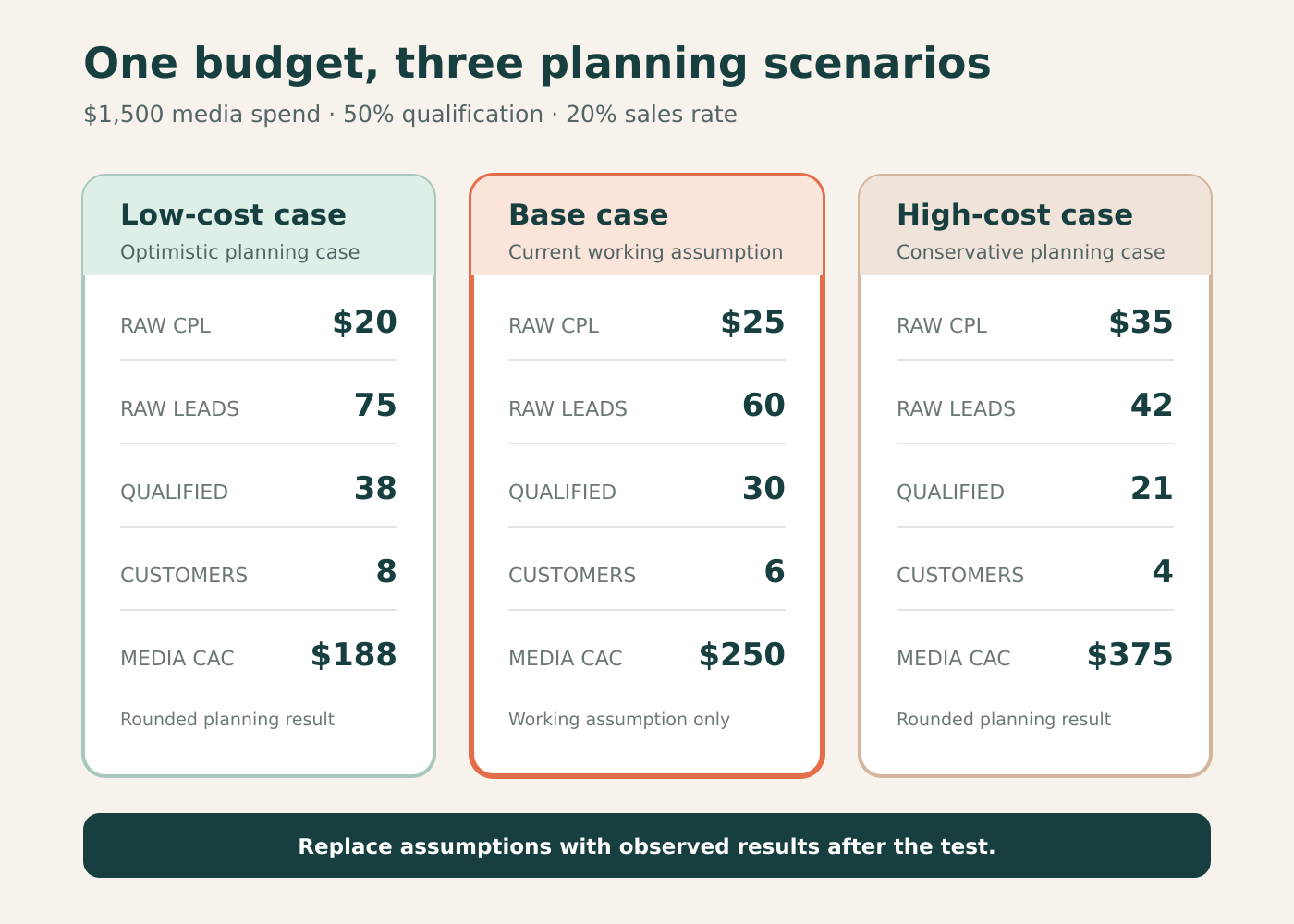
| Planning input or result | Low-cost case | Base case | High-cost case |
|---|---|---|---|
| Expected raw CPL | $20 | $25 | $35 |
| Estimated raw leads | 75 | 60 | 42 |
| Qualification assumption | 50% | 50% | 50% |
| Estimated qualified leads | 38 | 30 | 21 |
| Qualified-lead sales rate | 20% | 20% | 20% |
| Estimated customers | 8 | 6 | 4 |
| Media-only CAC | About $188 | $250 | $375 |
Rounding creates small differences. More importantly, the conversion rates may change when lead volume or audience changes. Therefore, do not treat the low-cost case as the “expected” result simply because it is more attractive.
Scenario A: a business with $500 available
At $20 raw CPL, $500 suggests 25 raw leads. At $35 CPL, it suggests about 14. If 40% qualify, the range falls to roughly six to ten qualified leads. If 20% of qualified leads buy, the expected customer count is about one or two.
Therefore, this small sample can reveal obvious problems. Still, it may not support confident scaling decisions, especially when sales take several weeks.
Scenario B: a business targeting 10 customers
Next, the business expects 40% qualification and a 25% qualified-lead sales rate. It therefore needs about 100 raw leads. At a $30 expected CPL, the base media plan is $3,000.
If the owner adds a 15% testing reserve, total planned media becomes $3,450. That percentage is an example, not a platform rule. The reserve should have a written purpose and release condition.
Scenario C: a local service with strong follow-up
For example, a local service expects 70 raw leads at a $22 CPL, producing a $1,540 media plan. If 60% qualify and 30% of qualified leads buy, the model suggests about 13 customers. Media-only CAC would be about $118.
Before launch, the business should confirm that staff can answer and follow up with 70 inquiries. Otherwise, a successful ad campaign may create an operational failure.
How to set a daily Meta ads budget for small businesses
Meta’s current developer reference supports daily and lifetime budgets at ad-set level. It also notes that minimum amounts depend on billing event, bid strategy, currency and other conditions. Therefore, confirm the current minimum shown in your own ad account.
Daily budget
For example, a daily budget is useful for ongoing campaigns and simple pacing. Divide the total media plan by active days to get an average. Then monitor actual delivery rather than assuming each day will match the average exactly.
Average daily budget = total media budget ÷ active campaign days
Lifetime budget
A lifetime budget sets a total amount across defined start and end dates. It can provide delivery flexibility within that schedule. However, the business still needs review points, stop rules and enough cash available for the planned period.
Choose a duration that matches the decision
Do not choose seven, 14 or 30 days only because another advertiser used that period. A suitable duration depends on expected lead volume, seasonality, conversion delay and follow-up speed. The review window should capture enough of the sales cycle to judge qualified outcomes.
Allocate the Meta ads budget between delivery, testing and reserve
In addition, a total campaign budget may need three labelled parts. First, fund the best-supported audience and offer. Second, reserve a controlled amount for creative or message testing. Third, keep a small contingency for reallocation.
| Budget component | Illustrative range | Purpose |
|---|---|---|
| Supported delivery | 60%–80% | Fund the strongest current audience, offer and creative. |
| Structured tests | 15%–30% | Test one meaningful variable with a defined question. |
| Contingency | 5%–15% | Cover volatility or reallocate after review. |
A new account may need more testing than an established account. However, every test should state what changes, what stays fixed and what result would justify further spend.
Keep media-only and all-in budgets separate
In practice, a Meta ads budget for small businesses may exclude creative production, landing-page work, agency fees, software, tax and sales labour. Track these costs separately or include them in an all-in total with a clear label.
The Marketing Budget Planner can organise channel and non-media allocations. For profitability, use the Campaign Profit Calculator after revenue and delivery costs become available.
Measure the whole Meta ads budget funnel, not only lead count
For instance, Meta’s Insights API can report campaign performance, including spend and advertising actions. However, the business must connect those records with CRM, booking and sales outcomes.
Create a simple lead-quality scorecard
| Metric | What to record | Why it matters |
|---|---|---|
| Spend | Meta media spend for the selected period. | Creates the numerator for media efficiency. |
| Raw leads | All captured records before cleaning. | Shows platform-level acquisition volume. |
| Valid leads | Real, reachable and in-scope records. | Exposes spam, duplicates and bad contact data. |
| Qualified leads | Leads meeting the written criteria. | Connects ads with genuine sales potential. |
| Appointments | Booked and attended next steps. | Shows follow-up and intent. |
| Customers | New customers under one definition. | Supports acquisition-cost analysis. |
| Contribution | Revenue minus selected variable delivery costs. | Tests whether acquisition is economically useful. |
Review quality by source and creative
Do not optimise only for the cheapest raw lead. Compare valid rate, qualification rate, appointment rate and customer rate. A creative that produces fewer leads may still win if its message attracts better-fit customers.
Also review the form and follow-up process. Weak questions may admit low-intent inquiries. Slow or inconsistent follow-up may cause good leads to appear unprofitable.
When to increase, hold or stop a Meta ads budget
Therefore, budget decisions need pre-written rules. Otherwise, one strong or weak day can cause emotional changes that make the campaign harder to evaluate.
Consider increasing spend when
- tracking and lead definitions are reliable;
- qualified CPL and customer acquisition cost are sustainable;
- results cover a meaningful part of the sales cycle;
- creative still matches the offer and audience;
- the team can handle more inquiries; and
- cash flow can support the next test.
Hold and investigate when
- raw CPL is acceptable but qualification is falling;
- sales have not matured because of conversion lag;
- tracking differs between Meta, the website and CRM;
- one audience or creative consumes most spend without clear quality; or
- the business has changed the offer, price or follow-up process.
Pause or stop when
- the campaign reaches its maximum affordable loss;
- lead quality stays outside the defined threshold;
- staff cannot follow up safely and consistently;
- the offer, page or tracking is broken; or
- customer acquisition cost exceeds the business limit without a justified test.
Most importantly, scaling should be a new controlled scenario, not an assumption that the current CPL will remain unchanged at every spend level.
Common Meta ads budgeting mistakes
- Starting with a daily number: connect spend to a lead or customer target first.
- Copying an industry benchmark: use it as context, then replace it with comparable account data.
- Counting every form as qualified: document valid and qualified criteria.
- Ignoring conversion lag: allow enough time for appointments and sales to mature.
- Mixing cost scopes: do not compare all-in CAC with media-only CPL.
- Testing too many changes: isolate a meaningful question where practical.
- Forgetting follow-up capacity: more leads are not helpful when no one can serve them.
- Scaling on one good day: review a compatible period and downstream quality.
- Having no stop rule: define maximum exposure before the campaign launches.
Meta ads budget planning checklist
| Area | Required decision |
|---|---|
| Objective | One primary campaign outcome and one lead definition selected. |
| Economics | Allowable media-only and all-in acquisition costs documented. |
| Assumptions | Low, base and high CPL, qualification and sales rates recorded. |
| Budget | Total, daily average, duration and maximum exposure approved. |
| Testing | Test question, variable, review point and release condition written. |
| Operations | Lead response owner, capacity and CRM stages confirmed. |
| Measurement | Spend, valid leads, qualified leads, sales and contribution connected. |
| Decision rules | Increase, hold and stop conditions agreed before launch. |
Meta ads budget for small businesses: frequently asked questions
Budget and lead estimates
How much should a small business spend on Meta ads per day?
There is no universal daily amount. Calculate a total test budget from expected CPL, target lead volume and campaign duration. For example, a $1,500 media budget over 30 active days averages $50 daily. Check that this amount can produce enough leads to evaluate while remaining affordable if results disappoint. Keep creative, agency, software and tax costs separate unless your plan explicitly includes them.
How much does a Meta lead cost in 2026?
Cost per lead varies by country, industry, audience, offer, objective, form, creative and season. WordStream reported a $27.39 median CPL across its 2026 sample of 452 US leads-objective campaigns, but that figure is context rather than a promise. Use recent data from your own comparable campaigns. If none exists, test a conservative range and replace it with observed qualified-lead cost.
How many Meta leads can a $500 budget generate?
Divide $500 by an expected raw CPL to create a scenario. At $20 CPL, the estimate is 25 raw leads; at $35, it is about 14. Those are not guaranteed results. If 40% of leads qualify, the range becomes roughly six to ten qualified leads. Apply your sales conversion rate afterward to estimate customers, and keep currency and definitions consistent.
Should I use a daily or lifetime Meta ads budget?
A daily budget is useful for ongoing campaigns and simple pacing. A lifetime budget sets a total for a defined schedule and gives delivery more flexibility across those dates. Meta supports both budget types at ad-set level. Choose the one that matches your control needs, then monitor actual spend. Delivery may vary, so confirm current account rules before launch.
Costs, testing and scaling
Should creative and agency fees be included in the Meta ads budget?
Track at least two views. Media budget includes only the amount delivered through Meta. All-in acquisition cost can include creative, agency, software, landing-page, sales and other relevant costs. Label each figure clearly. Do not compare an all-in cost from one period with media-only CPL from another because the calculation scopes are different.
What CPL should I use if I have no Meta ads history?
Start with a low, base and high range from the closest available evidence, such as the same country, objective and industry. Treat external benchmarks as rough context. Keep the first test financially safe, define a minimum sample and record valid and qualified leads. After the test, replace the borrowed assumptions with your own raw, valid and qualified CPL.
When should a small business increase its Meta ads budget?
Increase spend only after tracking is reliable, lead quality is acceptable, follow-up capacity exists and customer economics remain sustainable. Review a complete period that reflects conversion lag instead of reacting to one strong day. Scale in controlled steps, monitor qualified CPL and customer acquisition cost, and define a stop rule if costs rise or quality falls.
Why are my Meta leads cheap but sales are low?
Low raw CPL can hide duplicate, unreachable, out-of-area or low-intent records. Compare raw leads with valid leads, qualified leads, appointments and customers. Then review the offer, form questions, targeting, creative promise and follow-up process. A campaign with a higher raw CPL may be better if it produces lower qualified CPL and lower customer acquisition cost.
Turn ad spend into a controlled business decision
A practical Meta ads budget for small businesses connects four things: customer economics, funnel conversion, campaign cost and operational capacity. Begin with a total affordable exposure. Then create low, base and high CPL scenarios, apply qualification and sales rates, and convert the result into a daily average.
After launch, replace assumptions with observed valid, qualified and customer outcomes. Keep media-only and all-in costs separate. Most importantly, agree on scale, hold and stop rules before performance begins to influence the decision.
Sources and further reading
Continue planning


