
Party rental pricing should recover more than the purchase cost of a table, chair or tent. A sustainable rate must also pay for cleaning, inspection, storage, handling, delivery work, damage risk, business overhead and profit. The number a competitor publishes can help you check the market, but it cannot tell you whether that price covers your own operation.
This guide shows a practical method for building item rates and event charges. The examples use assumed U.S. dollars for explanation. Replace every number with your records, local tax treatment, insurance requirements and actual service process.
How should party rental pricing be calculated?
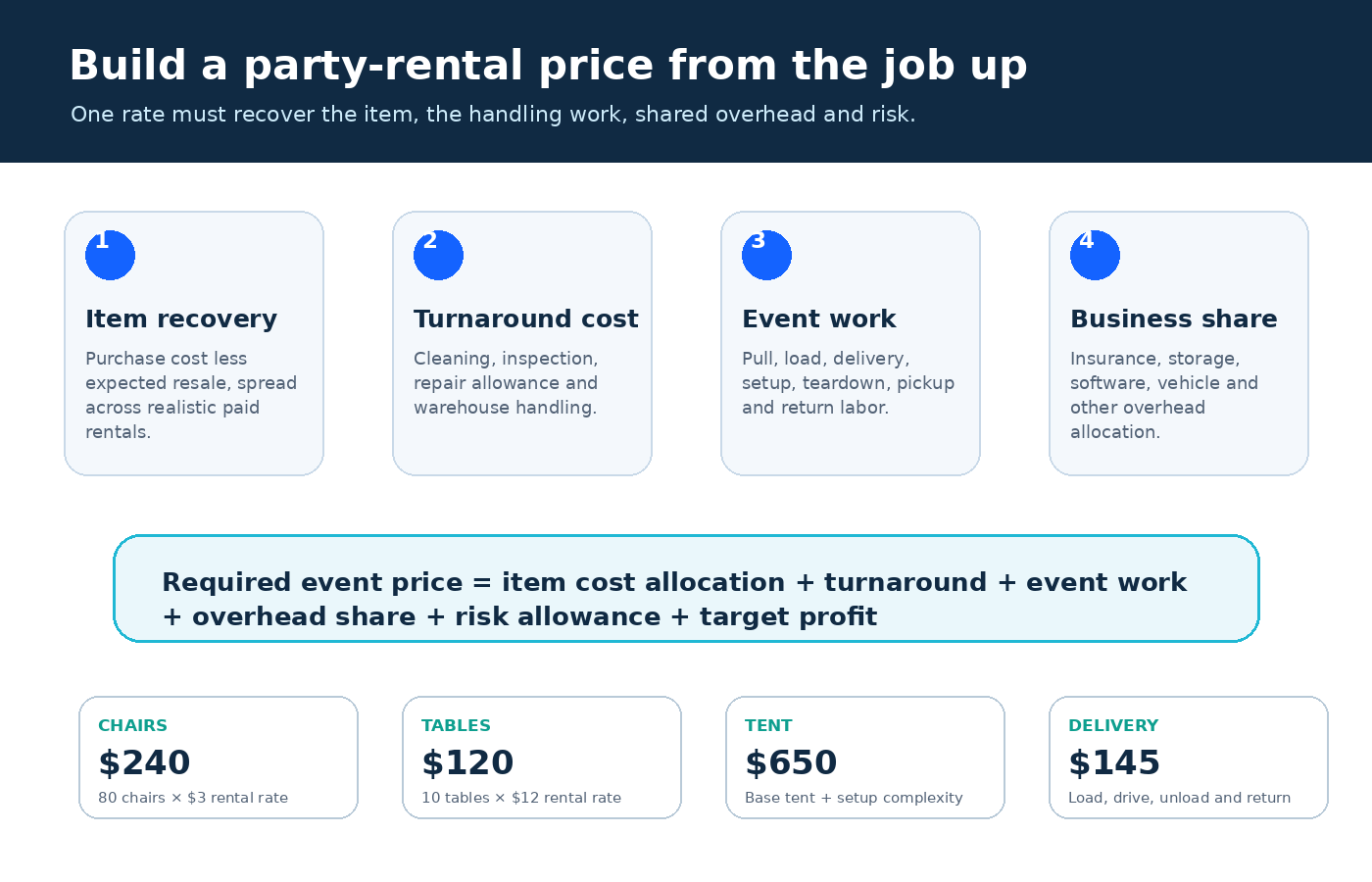
Start with the work and risk created by the event. The item rate is only one part of the customer price. A useful model keeps five components visible:
- Item recovery: the portion of purchase, replacement and disposal economics assigned to one paid rental.
- Turnaround: inspection, cleaning, packing, minor repair allowance and warehouse handling.
- Event work: sales administration, pulling, loading, transport, setup, teardown, pickup and return processing.
- Business share: storage, insurance, software, vehicle, management and other overhead allocated consistently.
- Risk and profit: the return required after normal operating costs and expected loss or damage exposure.
The U.S. Small Business Administration defines break-even as the point where total cost and total revenue are equal. Its unit formula divides fixed cost by price less variable cost. A rental business still needs a broader item and event model because one booking may combine many products, services and shared resources.
Calculate the item cost per paid rental
Do not divide purchase cost by calendar days. A chair may remain usable for years, but only paid rentals recover its cost. Estimate realistic paid uses over the period in which the item remains safe, presentable and commercially relevant.
Item recovery per paid rental = (purchase cost + acquisition and initial preparation − expected resale value) ÷ expected paid rentals.
Then add the per-rental turnaround allowance. If a chair costs $48 delivered, is expected to have $8 residual value and can complete 80 paid rentals, its basic recovery is $0.50 per rental. If cleaning, inspection, repair reserve and handling add $0.85, the item has already consumed $1.35 before event labor, delivery, overhead and profit.
This is an illustrative planning model. Replace expected life with actual retirement and repair data. A low-cost chair that stains, cracks or looks dated quickly can cost more per successful rental than a durable higher-cost item.
Separate owned inventory from event service
One booking can be profitable at the item level and unprofitable after delivery. Track the item rate and the service work as separate components. That separation makes it easier to see whether the chair price is weak or whether the business is undercharging for a difficult venue.
How do you calculate a chair rental price?
Chair pricing looks simple because customers compare a visible per-chair rate. However, the handling work scales with quantity. Count the time to inspect, stack, pull, load, unload, place, retrieve and recount the chairs.
Suppose the estimated item recovery and turnaround total is $1.35 per chair. Event handling adds $0.55, allocated overhead adds $0.30 and the required contribution before tax is $0.80. The resulting list rate is $3.00 per chair. For 80 chairs, the item line is $240 before delivery or setup.
Do not present this assumed rate as a national benchmark. Chair type, condition, service level, region, season and minimum order change the decision. Goodshuffle Pro publishes broad example ranges and purchase-cost rules of thumb, while also warning that operators must calculate from their own costs. Use such references to test the result, not to replace it.
Protect the minimum efficient quantity
A ten-chair order can create almost the same reservation, loading and travel administration as an eighty-chair order. Use a pickup minimum, delivery minimum or small-order handling fee where the job would otherwise fail the required contribution. State the rule before the customer confirms.
How do you calculate a table rental price?
Tables occupy more vehicle and warehouse capacity than their count suggests. Measure the labor and space used by each type. Round tables, banquet tables, cocktail tables and specialty wood tables should not share one recovery assumption.
Assume a banquet table has $4.25 in item recovery and turnaround, $2.25 in event handling, $1.50 in allocated overhead and a $4 required contribution. The proposed rate becomes $12 per table. Ten tables produce a $120 item line, again before delivery, setup, linens and tax.
Track damage and cleaning by product family. A low average across all tables can hide a costly specialty product. Also record the realized rate after discounts. Booqable recommends reviewing utilization, maintenance costs, sold-out periods, seasonal performance and delivery profitability instead of relying only on the list price.
How do you calculate a tent rental price?
Tent pricing needs a complete project model. The fabric and frame are only the starting assets. Installation complexity, crew time, transport, anchoring, site conditions, weather policy, inspection, drying, permits, engineering and insurance requirements may materially change the cost.
Build a base package for a defined tent size and clearly state what it includes. Then price optional or variable components separately:
- Sidewalls, gutters, flooring, lighting, weights and additional anchoring.
- Site visit, layout, permit support or utility-location requirements.
- Difficult access, restricted installation windows or additional crew.
- Extended rental duration, standby time, emergency change or delayed removal.
- Cleaning, damage, missing components and weather-related terms.
A percentage of purchase price can help screen whether a proposed rate is plausible. It does not capture event-specific labor and risk. Goodshuffle Pro notes that tents carry substantial labor, insurance and vehicle requirements. The business still needs its own verified installation and delivery model.
Do not hide safety and compliance inside the margin
Installation requirements and local rules can differ by tent, surface and jurisdiction. Confirm the manufacturer’s instructions, insurer requirements and applicable permits. Pricing cannot turn an unsafe or non-compliant setup into an acceptable booking.
How should delivery, setup and pickup be priced?
Distance alone is incomplete. Price the job created by the route. Include planning, pulling and loading time, round-trip driving, fuel or vehicle allocation, tolls, parking, access delays, unloading, setup, pickup, return travel and warehouse closeout.
Three practical structures are common:
| Structure | Useful when | Main control |
|---|---|---|
| Local zone fee | Jobs inside a consistent service area have similar access and load size | Define included distance and standard service |
| Distance plus labor | Travel and handling vary materially | Charge vehicle and crew time without double counting |
| Quoted logistics fee | Large tents, restricted venues or multi-trip events | Document assumptions and approval before booking |
Booqable’s rental-pricing guidance recommends pricing the cost to serve, including employee time, loading, fuel, parking and difficult destinations. A shorter city delivery can cost more than a longer easy route. Use records from completed jobs to update zones and minimums.
Use margin and markup correctly in party rental pricing
Markup and margin describe the same dollars from different denominators. If a job costs $600 and is sold for $900, the $300 difference is a 50 percent markup on cost and a 33.3 percent margin on price.
Price for target margin = included cost ÷ (1 − target margin).
For a $600 included cost and a 35 percent target margin, the price is $600 ÷ 0.65, or $923.08. This remains a planning result. Tax, refunds, unrecorded owner labor and broader business expenses can reduce what remains.
Use the free Artsians Profit Margin and Markup Calculator to check the arithmetic. Save the cost definition with the result so a later reviewer knows whether delivery, overhead and risk were included.
Design discount rules before the sales conversation
Discounts should have a reason and a limit. A longer rental may justify a lower effective daily rate when it reduces turnover work. A large item quantity may improve loading efficiency. A last-minute concession with no cost change simply reduces contribution.
Record list rate, discount reason and realized rate. If the average realized rate is far below list, fix the approval process or rate structure instead of treating the catalog price as evidence of profitability.
Worked party rental pricing example
A small operator prepares an illustrative quote for 80 chairs, 10 banquet tables and one 20-by-40-foot tent. The event needs delivery and standard setup. These are assumed figures for method testing.
| Line | Calculation | Illustrative price |
|---|---|---|
| Chairs | 80 × $3.00 | $240 |
| Tables | 10 × $12.00 | $120 |
| Tent base and standard setup | Project rate | $650 |
| Delivery and pickup | Local zone plus load class | $145 |
| Subtotal before tax | $1,155 |
If the complete expected cost is $720, the planned contribution is $435 and the planned margin is 37.7 percent. After the event, the operator should replace expected labor, mileage, damage and fees with actuals. A $1,155 invoice does not establish profit by itself.
The quote should also state rental dates, delivery and collection windows, included setup, customer responsibilities, payment schedule, damage terms, weather terms and change rules. Local legal and tax review remains necessary.
Build a rate card that staff can apply consistently
A rate card should remove avoidable negotiation while leaving a controlled route for genuine exceptions. For each product or service, record:
- Product identity, variation and standard rental period.
- List rate, multi-day structure and minimum quantity.
- Included cleaning, setup and service conditions.
- Delivery zone or logistics calculation.
- Damage deposit or waiver treatment where used.
- Tax treatment, approved discounts and approval owner.
- Cost basis, expected paid uses and last review date.
Review the card quarterly and before peak season. Compare booked quantity, utilization, sold-out dates, realized rate, turnaround cost, maintenance and profit by item family. Retire or reprice products that consume capacity without meeting the required return.
Use rental software to apply the rate, not invent it
Software can store rates, calculate quote lines and keep inventory and booking records connected. It cannot determine whether the rate is economically sound unless the business supplies complete cost and service rules.
RentPro by Artsians currently presents an early-access demonstration for rental quotations, equipment availability, booking-conflict checks and financial reporting concepts. The owner-supplied product material reviewed for this series describes a proposed $59 one-time price. It is not presented here as finished production software or a final purchasable offer.
Before operational use, verify current storage, backups, exports, concurrent editing, taxes, payment behavior, support, device compatibility, release status and terms. Test the rate card with difficult examples, including a package, multi-day booking, discount, delivery change and damaged return.
Frequently asked questions
How much should I charge to rent tables and chairs?
Start with the cost of owning and turning around each item, then add the event labor, delivery burden, overhead share, risk and required profit. Local competitor prices help test the result, but they cannot reveal whether another operator includes setup, delivery, cleaning or different equipment quality.
Should I price party rentals as a percentage of purchase cost?
A purchase-cost percentage can be a rough screening rule, but it should not be the final rate. It ignores useful life, paid rental frequency, repair, cleaning, storage, labor, delivery and discounts. Build a cost-based floor, then compare market demand and actual realized rates.
How do I price a tent rental?
Separate the tent asset from installation, transport and event-specific risk. Record tent size and components, realistic paid uses, inspection and repair allowance, crew hours, vehicle requirements, permits or engineering where applicable, site difficulty, weather rules and optional sidewalls, flooring or lighting.
Should delivery be included in the rental price?
It can be included when the service area and job profile are highly consistent. Many small operators need a separate delivery line because loading time, distance, access, parking, waiting and return travel differ by event. Publish the method clearly and apply it consistently.
What is the difference between markup and margin?
Markup divides profit by cost. Margin divides profit by selling price. A 50 percent markup does not create a 50 percent margin. Use one named method in the rate card and reports, then recalculate after discounts, refunds, damage or additional labor.
How often should party rental prices be reviewed?
Review item economics at least quarterly and before a major seasonal change. Compare utilization, realized rate, damage and maintenance, labor time, delivery profitability, discounts and sold-out periods. Change selected rates or rules deliberately rather than raising every item by the same percentage.
Should deposits and damage waivers count as rental revenue?
Keep refundable security deposits separate from rental revenue. A non-refundable damage waiver may be revenue under the business’s accounting treatment, but it also funds a defined risk. Use clear terms, local legal review and consistent bookkeeping instead of treating every collected amount as profit.
Can RentPro calculate the correct rate for my business?
RentPro’s early-access demonstration shows rental estimates, equipment availability and financial reporting concepts. It cannot know your local labor, delivery, insurance, tax, replacement and risk costs without complete inputs and production features. Verify the current scope, storage, terms and calculation behavior before operational use.
Sources and review notes
- U.S. Small Business Administration: Break-even point calculator
- Booqable: How to price party rentals
- Booqable: How to price rental inventory
- Goodshuffle Pro: How to price party rental items
- Artsians: Profit Margin and Markup Calculator
- Artsians: RentPro early-access page
External guidance and product material were reviewed on November 24, 2026. Recheck changing prices, software scope, laws, tax treatment and insurance requirements before publication or operational use.
Comments