
A professional car detailing estimate should tell the customer what will be done, which vehicle the price covers, what the total is and what could change it. Behind that customer-facing document, the detailer needs a private cost sheet for labor, supplies, travel, payment fees and overhead. After the job, estimated numbers should be replaced with actual time and costs so the business can see what the work really earned.
This guide gives a practical estimate-to-profit workflow for solo and small mobile detailing businesses. It includes a checked worked example, explains margin versus markup, and shows where DetailPro by Artsians can support the current workflow without overstating what its early-access preview does.
What should a professional car detailing estimate include?
A professional estimate is clear enough for the customer to understand and detailed enough for the business to reproduce. It identifies the vehicle, work, optional items, price basis and conditions that can change the final amount.
| Customer-facing field | What to record | Why it matters |
|---|---|---|
| Customer and vehicle | Name, vehicle year/make/model or agreed description, and service location | Prevents a quote for one vehicle or location from being applied to another. |
| Scope | Included interior, exterior, correction, protection or maintenance tasks | Defines what the customer is buying and gives the team a job checklist. |
| Add-ons | Pet hair, odor treatment, stain extraction, engine bay, headlights or other agreed work | Keeps additional work visible instead of hiding it inside a vague total. |
| Price | Base service, add-ons, discount, tax treatment, deposit and total | Lets the customer see how the payable amount was formed. |
| Terms | Validity period, payment timing, cancellation terms and change-order rule | Explains what happens if the job changes or the estimate expires. |
| Assumptions and exclusions | Condition level, access, water/power, hazardous material, mold, biohazards or damage outside scope | Reduces disputes when the vehicle differs materially from the information supplied. |
Private costs do not belong on the customer copy. The customer needs scope, price and terms. The business needs a separate internal calculation showing whether that price can cover the expected work.
Step 1: inspect the vehicle and define the scope
Good pricing begins before the arithmetic. Ask for vehicle type, size, condition, requested result and service location. For high-variation work, use current photos or an in-person inspection before issuing a firm price. Pet hair, stains, odors, overspray, oxidation and difficult access can change the required time and products.
Separate three decisions:
- What is included? List the exact tasks and surfaces.
- What is optional? Show add-ons and their prices separately.
- What could require a revised price? State the material condition or scope changes that trigger customer approval before extra work begins.
Use completed-job history to set a normal time and supply allowance for each package, vehicle-size tier and condition level.
Step 2: build the private job-cost estimate
The private calculation should contain every cost that matters to the decision. Include an owner-labor allowance even when a solo owner does not run payroll for themselves; otherwise, a long job can look profitable because the owner’s time was treated as free.
| Private cost input | Practical calculation | Common omission |
|---|---|---|
| Labor | Total worker-hours × loaded employee cost or owner-labor allowance | Counting only clock time when two people work simultaneously. |
| Supplies | Cost of chemicals, towels, pads and consumables expected to be used | Entering the bottle price instead of the portion used—or entering zero. |
| Travel | Chosen per-mile vehicle cost, tolls, parking and paid travel time where relevant | Charging for fuel but ignoring maintenance, wear or non-billable drive time. |
| Payment fees | Expected card or platform fee based on the planned payment method | Using the price before discount or forgetting a fixed transaction charge. |
| Other direct costs | Helper, rental, special product, disposal or subcontracted work | Hiding a one-off cost inside general overhead. |
| Allocated overhead | A consistent share of insurance, software, phone, marketing, equipment and administration | Leaving overhead out of every job because it is paid monthly. |
Avoid double counting. For example, do not put the full vehicle cost into overhead and also charge the same mileage cost to each job. Similarly, do not include a helper inside the labor rate and again as a separate direct cost.
The IRS optional business mileage rate became 76 cents per mile for qualifying U.S. travel on or after 1 July 2026. That tax measure is not automatically your vehicle’s operational cost or customer travel charge, so document the basis used in your estimate.
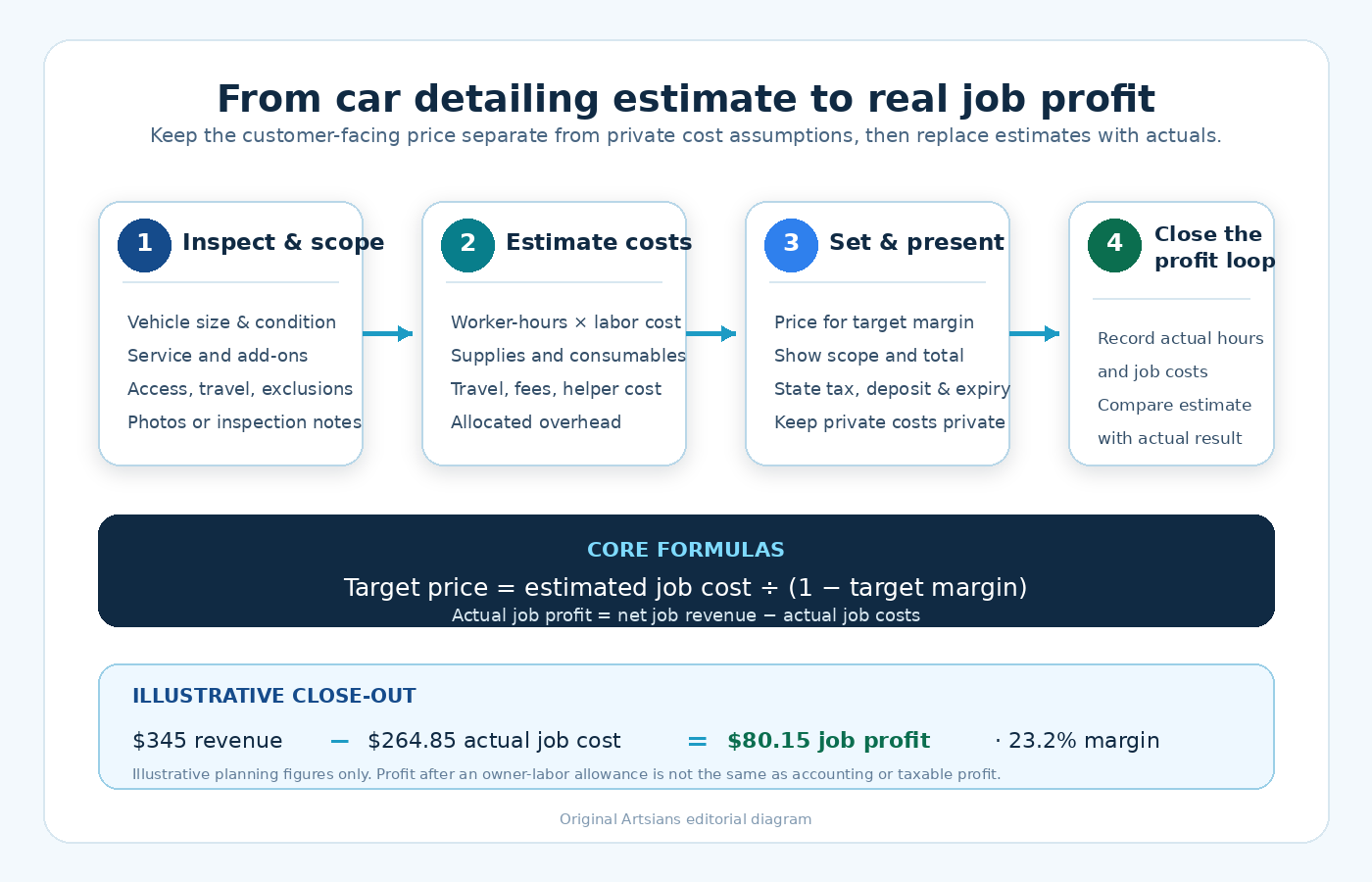
Step 3: set a price from cost and target margin
Once estimated job cost is complete, set a target margin that reflects your business, risk and local market. Use this formula:
Target price = estimated job cost ÷ (1 − target profit margin).
If estimated cost is $240 and the target margin is 30%, the calculation is $240 ÷ 0.70 = $342.86. A business might present $345 before applicable sales tax. The formula supplies a defensible floor, not a guarantee that every customer will accept it.
Do not confuse markup with margin
| Measure | Formula | Using $240 cost and $345 price |
|---|---|---|
| Job profit | Price − cost | $105 |
| Profit margin | Profit ÷ price × 100 | 30.4% |
| Markup | Profit ÷ cost × 100 | 43.8% |
A 30% markup is not a 30% margin. Use the Artsians Profit Margin and Markup Calculator to check the relationship after you have entered a complete cost basis.
Present the price without exposing the private calculation
Before sending the car detailing estimate, check that it shows the base service, add-ons, discount, tax and total while your cost assumptions remain private. Include a validity period and state that extra work requires approval. For condition-sensitive jobs, explain whether the price is preliminary until inspection or firm for the stated condition.
Worked example: estimate a full detail on a midsize SUV
This example is illustrative, not a recommended U.S. price. Replace every amount with your own time, costs, tax treatment and market conditions.
| Estimated private cost | Assumption | Amount |
|---|---|---|
| Owner-labor allowance | 5.0 hours × $30 | $150.00 |
| Supplies | Expected products and consumables | $32.00 |
| Travel/vehicle | Round-trip cost basis used by the business | $18.00 |
| Payment fee | Expected fee for the planned payment method | $12.00 |
| Allocated overhead | Consistent job share | $28.00 |
| Total estimated cost | $240.00 |
At a 30% target margin, the formula gives $342.86. The business rounds the pre-tax customer price to $345. That produces estimated job profit of $105 and an estimated margin of 30.4%.
The customer copy might show “Full interior and exterior detail—midsize SUV,” the included tasks, total price, tax treatment, appointment assumptions, expiry date and a condition-change rule. It would not show the $30 owner-labor allowance, expected supplies or private margin target.
Step 4: track actual job profit after completion
Close the job while details are fresh. Record service revenue before sales tax, approved changes, discounts or refunds, actual worker-hours and costs. Apply the same overhead method used in the estimate.
Actual job profit = net job revenue − actual job costs.
| Measure | Estimate | Actual | Variance |
|---|---|---|---|
| Worker-hours | 5.00 | 5.75 | +0.75 hours |
| Owner-labor allowance | $150.00 | $172.50 | +$22.50 cost |
| Supplies | $32.00 | $36.00 | +$4.00 cost |
| Travel/vehicle | $18.00 | $18.00 | $0.00 |
| Payment fee | $12.00 | $10.35 | −$1.65 cost |
| Allocated overhead | $28.00 | $28.00 | $0.00 |
| Total job cost | $240.00 | $264.85 | +$24.85 cost |
| Job profit | $105.00 | $80.15 | −$24.85 |
| Profit margin | 30.4% | 23.2% | −7.2 points |
The price was not automatically “wrong” because one job missed its target. However, repeated labor overruns on the same package are evidence. Adjust the normal time, condition surcharge, scope, process or package price before the next round of estimates.
Use variance to improve the next estimate
- If actual hours repeatedly exceed the estimate, revise the package time or inspection questions.
- If supply cost varies by service, set a realistic allowance for each package rather than one flat figure.
- If travel erodes short jobs, introduce a service radius, minimum job value or transparent travel rule.
- If discounts regularly remove the target margin, approve them against the private profit check rather than revenue alone.
- If a profitable service produces weak profit per labor hour, compare it with other uses of the same time.
This operational figure is not the same as accounting or taxable profit. The U.S. Small Business Administration recommends accounting for revenue and expenses and maintaining proper bookkeeping. Use a bookkeeper or qualified tax professional for formal records, tax treatment, payroll and financial statements.
How can DetailPro support this workflow today?
As checked on 19 November 2026, the public DetailPro preview demonstrates Overview, Jobs & customers, Quote builder, Expenses and Reports. The quote builder lets a visitor choose a sample service, change rate, vehicle quantity and extras, and print an estimate. The job register holds fictional customer, vehicle/model, date, value and status data. Expenses and reports show recorded revenue, recorded costs and recorded margin.
That makes the preview useful for testing a basic quote-to-record workflow. However, it does not currently demonstrate a private cost build-up inside each quote, automatic estimate-to-job conversion, actual hours, estimated-versus-actual variance, invoices, payments, deposits, tax calculation or accounting integration. Do not assume those features.
DetailPro remains in early-access validation. Its product page displayed a proposed one-time price of $49 USD when checked, but no payment was collected. Release timing, final terms, device compatibility and production scope still require confirmation before publication and before any purchase decision.
Seven mistakes that make estimates look profitable when they are not
- Treating owner time as free. Add an owner-labor allowance for pricing even when its accounting treatment differs.
- Counting elapsed time instead of worker-hours. Two people working three hours create six worker-hours.
- Calling revenue profit. Revenue becomes a useful profit measure only after the chosen cost scope is deducted.
- Using markup as margin. Check both measures before presenting the price.
- Leaving condition undefined. A package price without a condition assumption invites disputes.
- Never closing the job. Estimates cannot improve when actual time and costs are never recorded.
- Changing the cost method from job to job. Use consistent definitions so packages can be compared honestly.
A repeatable estimate-to-profit checklist
- Inspect the vehicle or collect enough reliable condition evidence.
- Define included work, add-ons, assumptions and exclusions.
- Estimate total worker-hours and private job costs.
- Calculate a target price, then check local market and customer value.
- Present scope, price, tax, deposit, expiry and change terms clearly.
- Obtain approval before extra work changes the price.
- Record actual revenue, time and costs immediately after completion.
- Review variance by package, vehicle size and condition each month.
A strong car detailing estimate ends with a clean comparison between what the business expected and what actually happened. That feedback loop turns quoting from guesswork into a pricing system.
Frequently asked questions
What should a car detailing estimate include?
It should identify the customer and vehicle, describe the included work, list add-ons, show the price and applicable tax or deposit treatment, state how long the offer is valid, and explain assumptions, exclusions and the process for approving extra work.
Should the customer see my costs and profit margin?
Usually no. The customer-facing estimate should show scope, price and terms. Labor cost, supply allowances, travel assumptions, overhead and target margin are private planning inputs used to test whether the price can support the business.
What is the difference between an estimate and an invoice?
An estimate projects the scope and price before work is approved or completed. An invoice requests payment for agreed or completed work. The legal effect can depend on the wording and local rules, so use consistent terms and review applicable requirements.
How do I calculate profit on a detailing job?
Subtract actual job costs from net job revenue before sales tax. Include the cost categories chosen for the decision, such as labor or owner-labor allowance, supplies, travel, payment fees, helper cost and allocated overhead. Divide job profit by net job revenue to calculate job margin.
Should a solo detailer count their own labor as a job cost?
For pricing analysis, an owner-labor allowance prevents personal time from appearing free and helps compare jobs consistently. Its bookkeeping and tax treatment may differ from employee wages, so keep the planning measure clearly labeled and use professional advice for formal accounts.
How should I allocate overhead to a detailing job?
Choose one consistent method, such as overhead per billable hour, per job or as a percentage of revenue. Avoid counting the same expense in both direct job cost and overhead. Review the method when workload, equipment, insurance, rent or marketing costs change materially.
What does the current DetailPro demo show?
The public preview shows sample estimates, fictional customer and vehicle records, booking status, expenses, completed revenue, recorded margin and sample report export. It does not currently demonstrate private quote costs, time tracking, estimate-to-actual variance, invoicing, payments or accounting integration.
Is DetailPro available to buy now?
No. DetailPro is in early-access validation. Its page displayed a proposed one-time price of $49 USD when checked on 19 November 2026, but no payment was collected. Final terms, compatibility, release timing and production scope still require confirmation.
Sources and review notes
- Artsians: DetailPro product page — proposed price and early-access boundaries; checked 19 November 2026.
- Artsians: DetailPro interactive demo — sample modules and fictional workflow; checked 19 November 2026.
- Artsians: DetailPro quoting guide — sample arithmetic and limitations.
- Artsians: Profit Margin and Markup Calculator.
- U.S. Small Business Administration: Manage your business — bookkeeping context.
- Internal Revenue Service: 2026 mileage-rate revision.
- Jobber: Car detailing pricing — cost and margin framework.
- DetailMetrik: Auto detailing estimates — private job-cost example.
Editorial note: All prices and costs in the worked example are illustrative. This article is operational guidance, not accounting, tax or legal advice.
Comments