

The practical reality is less dramatic and more useful. OpenAI says ChatGPT Search ranks results using multiple factors intended to help users find relevant, reliable information, and that placement is not guaranteed. The job is therefore to remove access barriers, make each page easy to understand, demonstrate why the business is credible, and publish information that closely fits the user’s need.
First, understand what “recommended in ChatGPT Search” means
A ChatGPT response can surface a website in several ways: as a cited source supporting a factual answer, a link in a set of relevant results, a local business option, or a product or merchant result. These are not identical placements. The best page for “What does this service cost?” may be different from the best page for “Which provider is suitable for a 20-person company?”
ChatGPT can also rewrite a conversational request into more targeted searches and use third-party search providers. That means ordinary search fundamentals still matter. A page that is blocked, thin, inconsistent or difficult for search systems to interpret is unlikely to become more useful simply because the interface is conversational.
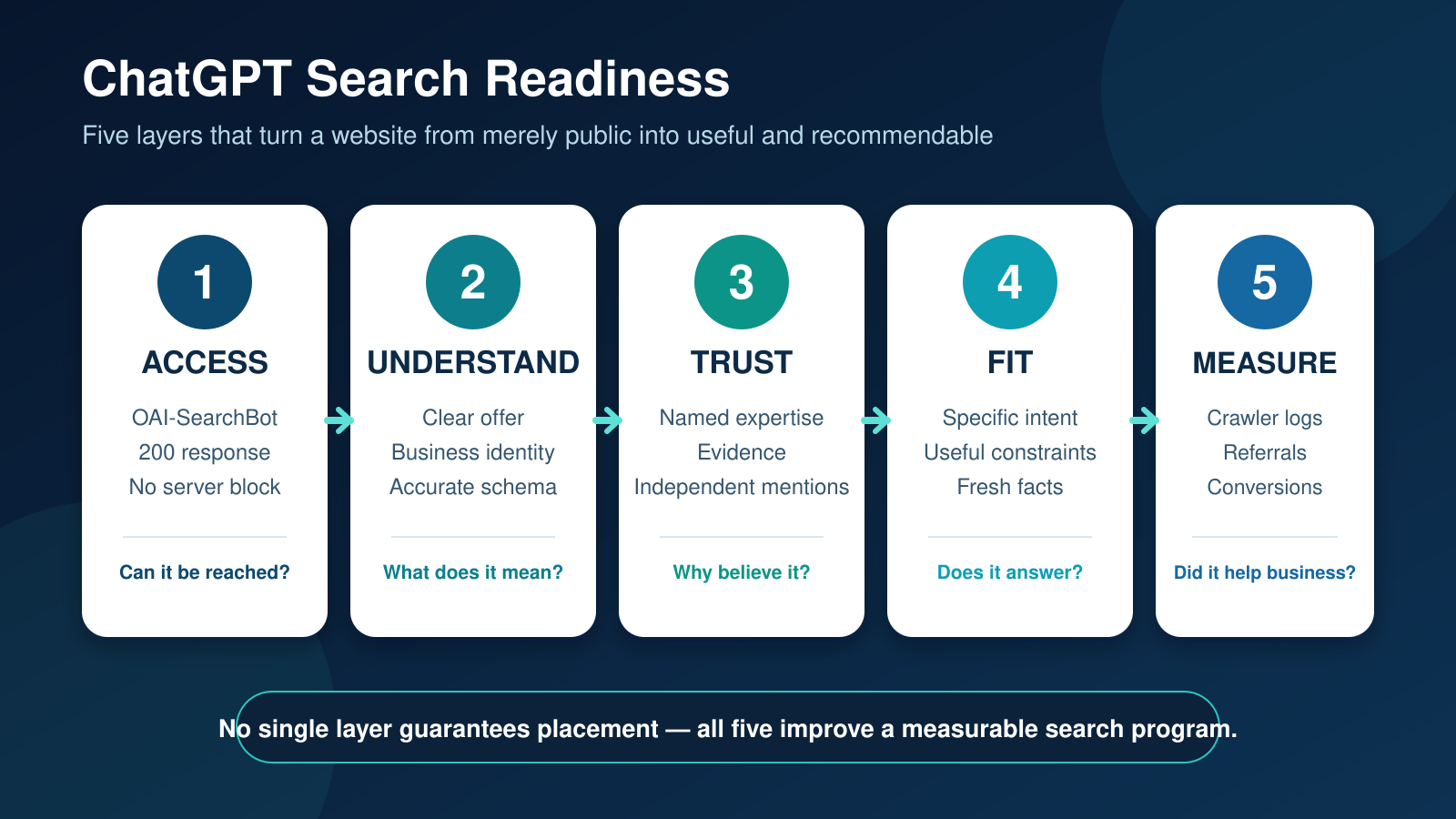
Use the following five-layer model:
| Layer | Main question | Evidence to check |
|---|---|---|
| 1. Access | Can the relevant crawler reach the page and its important resources? | robots.txt, firewall/CDN rules, status code and server logs |
| 2. Understanding | Is the business, offer, location and page purpose unambiguous? | title, heading, visible copy, internal links and structured data |
| 3. Trust | Why should the claims be believed? | authorship, evidence, policies, case studies, reviews and independent mentions |
| 4. Retrieval fit | Does the page directly satisfy a specific customer request? | clear answer, relevant facts, comparisons, constraints and freshness |
| 5. Measurement | Are improvements producing qualified discovery and conversions? | analytics, logs, landing pages, leads, revenue and assisted conversions |
1. Allow OAI-SearchBot and remove server-level blocks
OpenAI documents OAI-SearchBot as the crawler used to surface websites in ChatGPT search features. A site that opts out will not be shown in ChatGPT search answers, although OpenAI notes that a navigational link can still appear in some circumstances.
A simple allow rule is:
robots.txt example
User-agent: OAI-SearchBot
Allow: /
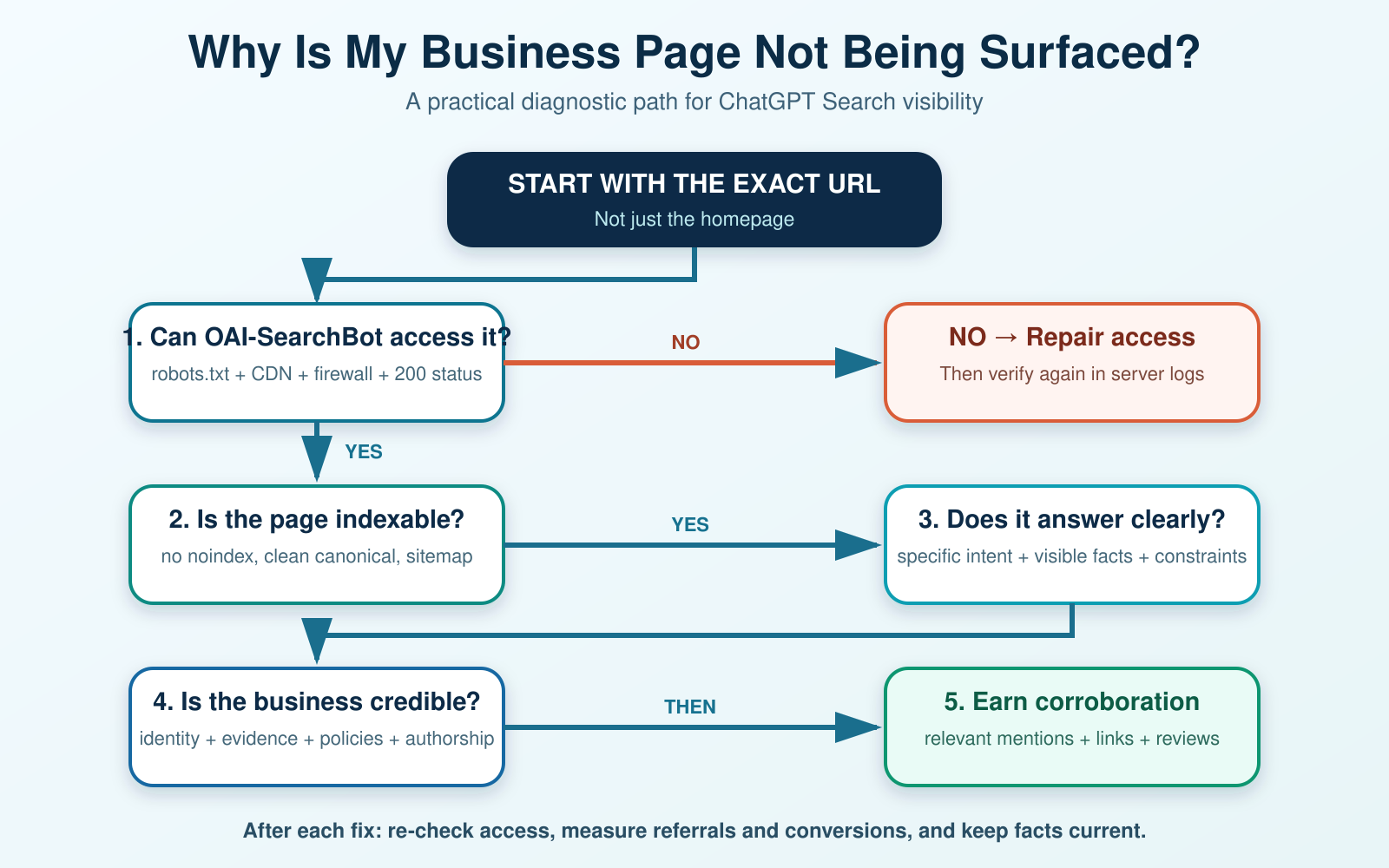
Do not stop at robots.txt. A CDN, web application firewall, security plugin, rate limiter or hosting provider can still reject the crawler with a 403, 429 or challenge page. Ask the technical team to permit requests from OpenAI’s published OAI-SearchBot IP ranges and verify the response in server or CDN logs.
OAI-SearchBot and GPTBot serve different purposes. OAI-SearchBot controls search discovery; GPTBot concerns potential use of crawled content for model training. OpenAI says the settings are independent, so a business can allow search access without making the same choice for model-training access.
After a robots.txt update, OpenAI says its systems may take about 24 hours to adjust. That is not a guarantee that a page will be crawled, cited or ranked within a day.
Technical access checklist
- The important URL returns a normal 200 response without login, cookie wall or bot challenge.
- robots.txt does not disallow the page, its directory or critical assets.
- The page does not contain an accidental noindex directive.
- Canonical tags point to the preferred public URL.
- Important facts exist in readable HTML, not only inside an image, video or script-dependent widget.
- CSS, JavaScript and image hosts required to understand the page are not blocked unnecessarily.
2. Confirm search-engine discovery and indexability
OpenAI explains that ChatGPT Search may work with third-party search providers. Therefore, a business should not treat OAI-SearchBot as a replacement for Google or Bing visibility. Maintain a clean XML sitemap, submit it in Google Search Console and Bing Webmaster Tools, and investigate important URLs that remain undiscovered or excluded.
Google’s SEO Starter Guide recommends making pages easy to crawl, index and understand. Bing likewise supports sitemap submission and URL submission or IndexNow for faster discovery of changed content. These actions improve discovery; they do not force ChatGPT to cite a page.
Audit the exact landing page, not just the homepage
If a customer asks for “emergency commercial electrician in Manchester,” a generic homepage may not provide enough information. Test the specific service-and-location page. Confirm its status code, canonical, indexability, visible content and internal links. Repeat for core product, pricing, comparison, support and policy pages.
For duplicate or parameterized URLs, select one canonical version and link to it consistently. Avoid publishing near-identical city pages that only swap place names; each page should contain genuine local information, service boundaries, availability and proof relevant to that location.
3. Build pages around real customer decisions
Conversational search often includes context: budget, location, deadline, industry, company size or a specific constraint. A strong business page answers those details more clearly than a broad promotional page.
| Customer need | Best page type | Facts to include |
|---|---|---|
| “Who offers this service near me?” | Location or service-area page | Areas served, address or coverage, hours, contact route and local proof |
| “How much will this cost?” | Pricing or cost guide | Ranges, inclusions, exclusions, variables, currency and update date |
| “Which option suits my business?” | Comparison or use-case page | Ideal user, limitations, trade-offs, setup and realistic examples |
| “Can this provider be trusted?” | About, case study or policy page | Named team, experience, method, evidence, terms and verifiable outcomes |
| “Is this product available now?” | Product detail page | Price, stock, variants, delivery, returns, images and seller identity |
Lead with a direct answer, then provide evidence and nuance. Use descriptive headings, short paragraphs, lists and comparison tables where they genuinely clarify the decision. There is no magical word count. The page should be complete enough to resolve the customer’s question without padding.
Avoid keyword stuffing. If you use Artsians’ Keyword Density Checker, treat it as a repetition warning, not a target generator. The goal is natural coverage of the topic, related entities and customer language.
4. Make the business entity unmistakably clear
A search system should not have to guess whether two names, locations or profiles refer to the same business. Use a consistent official name, website URL, phone number, service area and description across the website and legitimate external profiles.
At minimum, maintain:
- A complete About page that explains who operates the business and what it does.
- A Contact page with current channels, location or service area, and opening hours where relevant.
- Clear service or product pages linked from the main navigation.
- Visible legal, privacy, shipping, return, refund or cancellation policies appropriate to the business.
- Author or reviewer details for advice-heavy content.
- Consistent profiles on relevant directories, associations and social platforms.
If a company has changed its name, domain or location, update old citations and redirect retired URLs. Conflicting identity signals create friction for users and machines.
5. Publish evidence-backed content people would actually recommend
Google’s official guidance on helpful, reliable, people-first content asks whether a page offers original information, substantial value, clear sourcing and demonstrable experience. Those principles are sensible beyond Google because a recommendation is only useful when the underlying source is trustworthy.
For a business website, useful evidence may include:
- A named methodology explaining how the service is delivered.
- Case studies with the starting problem, scope, timeline, actions and measured result.
- Original photographs, screenshots or examples that the business has permission to publish.
- Transparent pricing logic and limitations instead of a vague “best price” claim.
- Quotes or statistics linked to their primary source.
- Dates on information that can become stale, with a real review process.
- Clear disclosure of affiliate, sponsored or AI-assisted content where relevant.
Do not invent awards, reviews, client logos, locations or authors. Do not present generated people as customers. Trust signals work only when they are verifiable.
6. Use accurate structured data—without inventing “AI schema”
There is no official special “ChatGPT schema” that guarantees a recommendation. Use established Schema.org vocabulary to describe information that is already visible on the page. Depending on the business and page, relevant types may include Organization, LocalBusiness, Service, Product, Article and BreadcrumbList.
Structured data should:
- Match visible facts exactly.
- Use the canonical URL and stable business identifiers.
- Include only real ratings, prices, availability and locations.
- Avoid duplicate or conflicting markup from multiple plugins.
- Be validated after deployment.
Markup helps machines understand a page but cannot compensate for weak content, blocked crawling or a poor reputation.
7. Strengthen internal links and site architecture
Internal links show how services, locations, guides and tools relate. Create a simple path from broad pages to specific decision pages. A service page can link to pricing, an implementation guide, a relevant case study and the contact page. A guide can link back to the service only where the next step is genuinely helpful.
Use concise, descriptive anchor text. “View our small-business SEO audit process” is more informative than “click here.” Keep important pages within a few sensible navigation steps and repair orphan pages that have no internal links.
Before publication, preview each title and description with the Artsians SERP Preview Tool. Use the Word & Character Counter to keep page titles, summaries and social copy concise, but prioritize accuracy over an arbitrary character target.
8. Earn off-page authority without manufacturing backlinks
Off-page SEO is not a list of links that can be placed inside a ZIP file. A backlink exists only when another site chooses to link. The sustainable approach is to create a resource worth citing and promote it to relevant people.
| Linkable asset | Relevant outreach targets | Responsible pitch |
|---|---|---|
| Original benchmark or anonymized trend report | Trade publications, associations and analysts | Share method, sample limits and a concise finding they can verify |
| Practical calculator or checklist | Educators, agencies, small-business hubs and newsletters | Explain the audience problem it solves; do not demand exact-match anchor text |
| Detailed case study | Partners, vendors and industry media | Offer a transparent story with permission and measurable evidence |
| Expert commentary | Journalists, podcasters and niche publishers | Respond quickly with a clear, non-promotional answer and disclosed credentials |
| Local resource | Chambers, local directories and community organizations | Provide accurate local value and keep business details consistent |
Avoid paid link networks, automated guest-post blasts, fake review sites and mass-produced “best company” lists. These tactics create weak or deceptive signals and expose the business to reputational and search risk.
9. Add the extra signals your business model needs
Local service businesses
Keep address, phone, hours and service area consistent. Publish useful location-specific pages and earn mentions from legitimate local organizations. Make emergency availability, booking requirements and geographic limits explicit. Because ChatGPT may use location context for nearby results, accurate location information matters.
Professional and B2B services
Explain the process, ideal client, minimum engagement, delivery model, compliance boundaries and what the service does not cover. Publish named expertise, case studies and decision guides rather than generic thought-leadership summaries.
Ecommerce businesses
Keep product titles, descriptions, images, price, availability, variants, shipping and returns current. OpenAI says product results can use structured metadata from first- and third-party providers. Shopify catalog data may already be integrated, while approved merchants can apply for direct OpenAI product feeds to share fresher catalog data. Product-feed access and shopping visibility are separate from ordinary website citations.
10. Measure visibility as a funnel, not a vanity score
There is no universal “ChatGPT rank” because answers vary by query, context, location and time. Build a repeatable measurement process instead.
- Define query groups: branded, local, service, comparison, problem and product questions.
- Record the baseline: whether the business appears, which page is cited and which alternatives are surfaced. Do not automate aggressive querying.
- Monitor access: review server logs for OAI-SearchBot responses and investigate blocks or repeated failures.
- Track traffic: review analytics for chatgpt.com referrals, landing pages, engagement and conversion events. Attribution may be incomplete.
- Track business outcomes: qualified enquiries, calls, sign-ups, revenue and assisted conversions matter more than mentions alone.
- Annotate changes: record technical fixes, content updates, new links and major business changes so results can be interpreted.
Use the UTM Link Builder for campaigns and links you control. Do not add campaign parameters to canonical internal links. Connect visibility to commercial performance with the Marketing ROI Calculator, and evaluate whether automation work is worthwhile with the AI Automation Savings Calculator.
A practical 30-day implementation plan
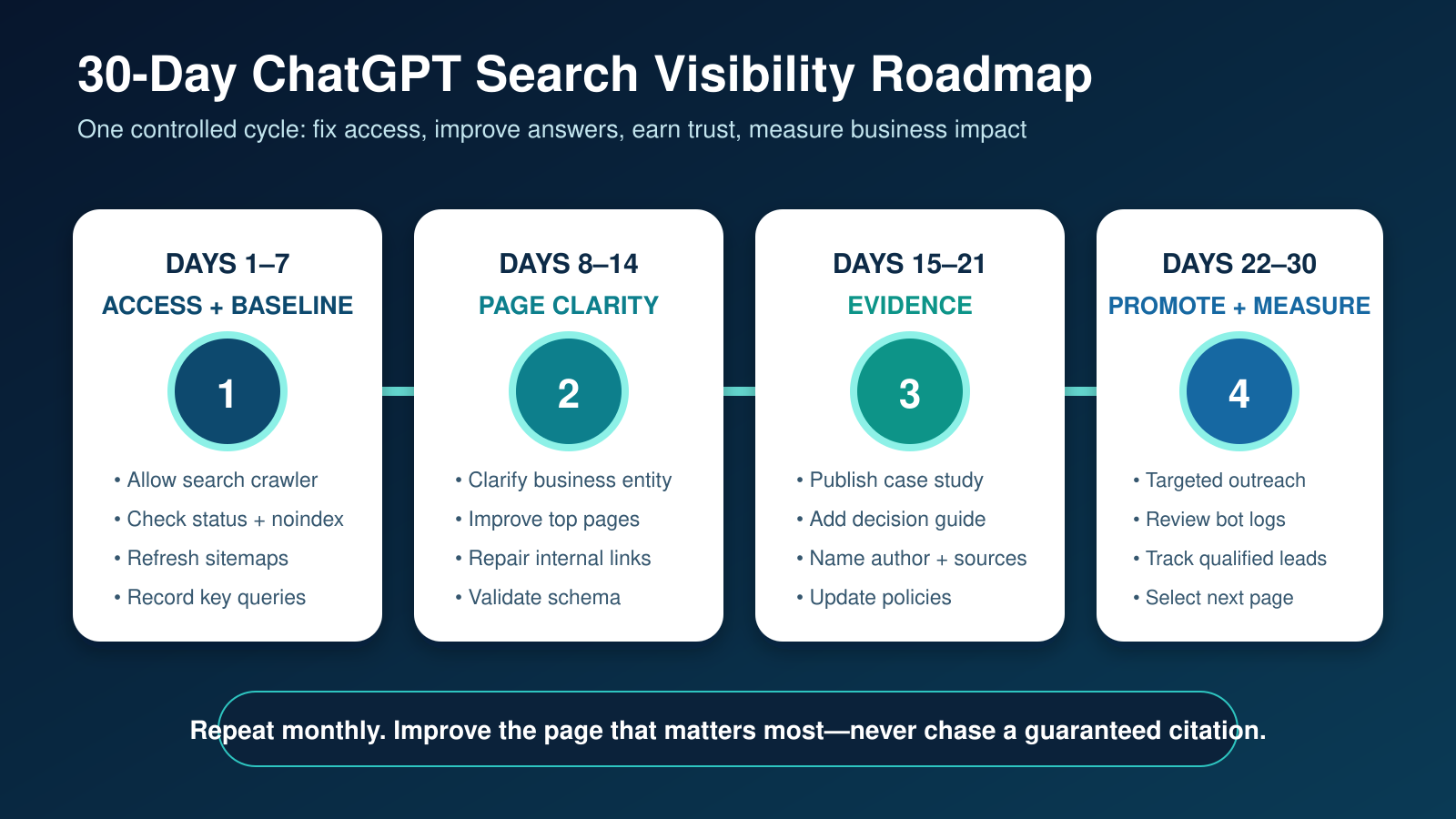
Days 1–7: Access and baseline
- Check OAI-SearchBot rules, firewall logs, status codes, noindex directives and canonicals.
- Submit or refresh XML sitemaps in Google and Bing.
- List the ten to twenty queries that matter commercially.
- Record current citations, referral traffic and conversion baseline.
Days 8–14: Core page clarity
- Rewrite the homepage, About and Contact pages so the business identity is unambiguous.
- Improve the top three service or product pages with direct answers, constraints and evidence.
- Correct titles, headings, internal links and thin or duplicated sections.
- Add or repair accurate Organization, LocalBusiness, Service or Product markup where appropriate.
Days 15–21: Evidence and decision content
- Publish one transparent case study or original practical resource.
- Create one pricing, comparison or implementation page that resolves a real sales question.
- Add authorship, review details, sources and update responsibility.
- Improve policies and product or service facts that are often missing from customer decisions.
Days 22–30: Promotion and measurement
- Contact a small, relevant list of partners, associations, publishers or communities.
- Repurpose the resource for useful social posts and track engagement with the Social Media Engagement Rate Calculator.
- Verify crawler responses, index status, structured data and page performance after deployment.
- Review qualified traffic and leads, then select the next page based on evidence.
Common mistakes that reduce ChatGPT Search visibility
- Blocking the crawler: robots.txt allows access, but the CDN returns a challenge or 403.
- Publishing generic AI summaries: the page adds no first-hand evidence, analysis or business-specific value.
- Hiding facts in visuals: pricing, process or service details exist only in an infographic.
- Creating fake authority: fabricated reviews, authors, locations, awards or backlinks undermine trust.
- Using conflicting business details: the name, phone, address or service area differs across pages and profiles.
- Adding unsupported schema: markup claims ratings, stock or services that users cannot see.
- Chasing a single prompt: the team ignores the wider customer journey and conversion quality.
- Expecting instant results: technical eligibility is only the first layer; relevance and reliability still determine selection.
Final ChatGPT Search readiness checklist
| Check | Pass condition |
|---|---|
| OAI-SearchBot access | Allowed in robots.txt and not blocked by hosting, CDN or firewall |
| Public page access | 200 response, no login requirement and no accidental noindex |
| Canonical URL | One preferred public URL used consistently in links and markup |
| Business identity | Name, offer, location, contact details and policies are clear and consistent |
| Customer intent | Each important page answers a specific real-world question or decision |
| Evidence | Claims are supported by experience, sources, examples or verifiable outcomes |
| Structured data | Relevant Schema.org markup matches visible content and validates cleanly |
| Internal links | Important pages are discoverable through useful, descriptive links |
| External reputation | Relevant independent mentions, reviews and earned links exist |
| Measurement | Logs, referrals, landing-page conversions and business outcomes are reviewed |
Frequently asked questions
Can I pay OpenAI to recommend my business in ChatGPT Search?
Organic ChatGPT Search placement is not guaranteed. OpenAI says search ranking uses multiple factors intended to surface relevant, reliable information. Ads and organic or product results are separate, so paying for promotion does not guarantee an organic recommendation.
What is the difference between OAI-SearchBot and GPTBot?
OAI-SearchBot is used for ChatGPT search visibility. GPTBot relates to potential model-training use. OpenAI documents these controls separately, so a site can allow OAI-SearchBot while disallowing GPTBot.
Do I need special ChatGPT schema markup?
No official special ChatGPT schema is required. Use accurate, relevant Schema.org types such as Organization, LocalBusiness, Service, Product, Article and BreadcrumbList where they match visible page content.
How long does an OAI-SearchBot robots.txt change take?
OpenAI says its systems may take about 24 hours to adjust after a robots.txt change. That timing concerns crawler-rule processing; it does not promise crawling, inclusion, a citation or a particular position.
Does ranking in Google or Bing guarantee a ChatGPT citation?
No. Traditional search visibility can improve discovery, and ChatGPT may use third-party search providers, but OpenAI does not promise that any indexed page will be cited or recommended for a particular request.
How can I measure traffic from ChatGPT?
Review analytics referral and source data for chatgpt.com, inspect landing pages and conversions, and check server logs for OAI-SearchBot. Use campaign parameters only on links you control; do not assume every ChatGPT visit will be attributed perfectly.
Do backlinks help a website appear in ChatGPT Search?
Relevant, earned links and mentions can improve discovery and corroborate a business’s reputation across the web, but no backlink guarantees a ChatGPT recommendation. Prioritize genuine industry sources, associations, partners and useful original research.
What should an ecommerce business do in addition to SEO?
Keep product pages, price, stock, images, shipping and return information accurate. Shopify catalog data may already be integrated, while approved merchants can apply for OpenAI’s direct product-feed program to provide fresher structured catalog data.
The practical takeaway
The most reliable strategy is not to optimize for a mysterious AI preference. Make the website technically accessible, publish pages that resolve specific customer decisions, demonstrate genuine expertise, keep business facts consistent, and earn independent corroboration. These improvements help people, traditional search engines and AI-assisted search at the same time.
Start with one commercially important page. Verify access, rewrite it for clarity, add evidence, connect it to the rest of the site and measure the resulting traffic and leads. Then repeat the process. That disciplined cycle is more defensible than any promise of a guaranteed ChatGPT recommendation.
Comments