

Want to use ChatGPT for digital marketing but not sure what to ask—or what to trust? Start with one real marketing job, give ChatGPT the same context you would give a new team member, and treat its response as a working draft rather than finished work. This beginner guide walks you through that process step by step, with prompts you can copy, a small-business example, quality checks, and a realistic 30-day plan.
Here is the short version: ChatGPT can help you research questions, organize a campaign, draft channel-specific content, analyze a spreadsheet, and turn one idea into several useful assets. It should not decide your strategy, invent customer facts, or publish unsupervised. You provide the judgment; ChatGPT helps with the heavy lifting between a blank page and a reviewable first draft.
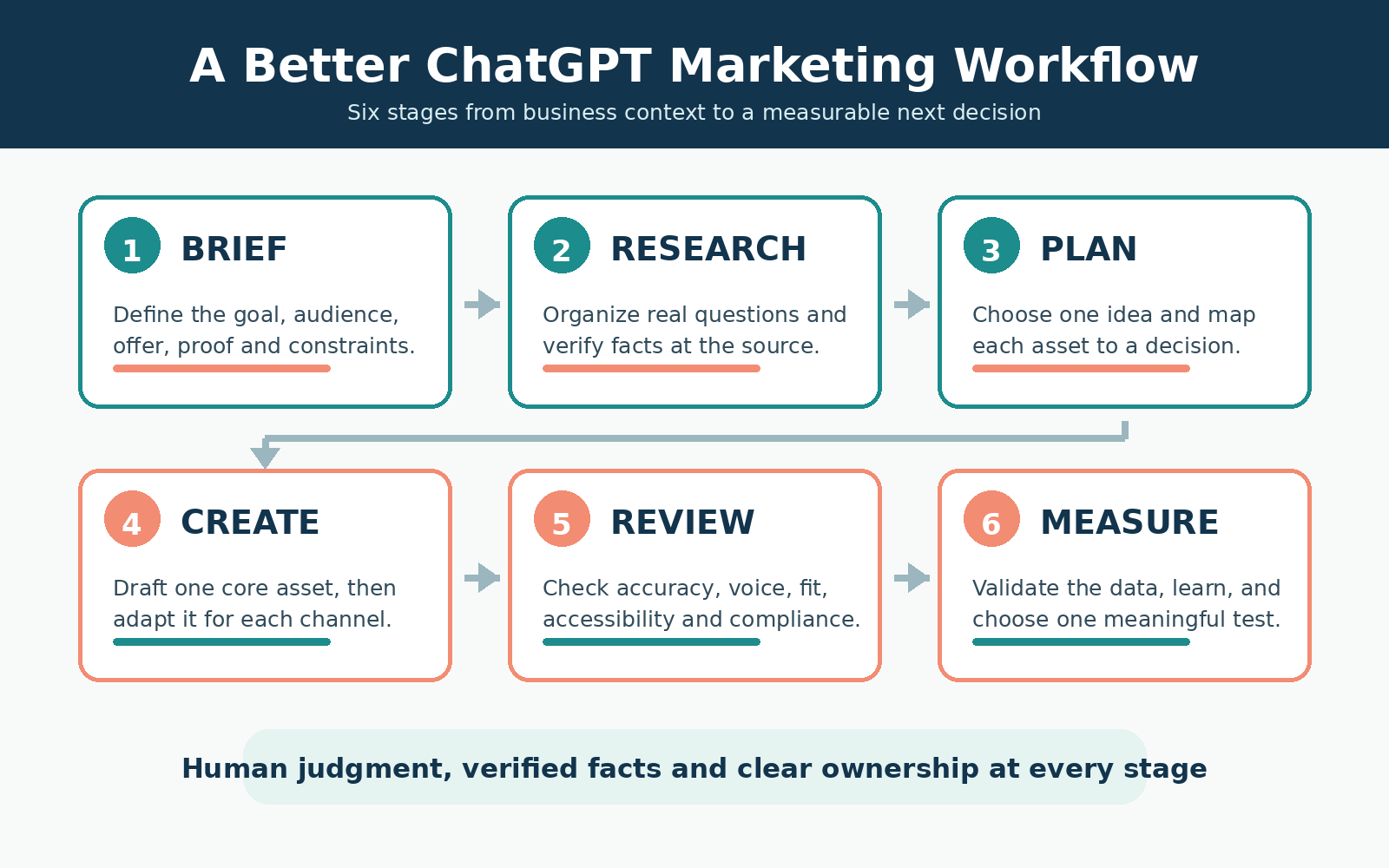
What can ChatGPT do for digital marketing?
ChatGPT is a conversational assistant, not a marketing channel. OpenAI’s current capabilities overview describes tools for writing, web search, image work, file uploads, data analysis, Projects, and more. Availability and usage limits can vary by plan and workspace, so build your workflow around the tools you can actually access.
For a beginner, the most useful jobs are usually:
- Audience research: organize interview notes, reviews, support questions, and survey responses into themes.
- Campaign planning: turn a goal, audience, offer, and deadline into a channel plan and checklist.
- Content ideation: generate angles based on real customer questions instead of random topic lists.
- Drafting and repurposing: create a first draft, then adapt it for email, social, landing pages, or video.
- SEO assistance: cluster search questions, outline an article, improve clarity, and draft metadata for human review.
- Data analysis: summarize a CSV, calculate changes, spot patterns, and create a chart when data analysis is available.
- Creative support: produce visual concepts, briefs, shot lists, or images where the selected plan supports it.
What should stay with a person? Positioning, final claims, customer empathy, legal approval, taste, and the decision to publish. ChatGPT can sound confident even when its answer is wrong. It may miss context, use outdated facts, or smooth over an important exception. That is why every workflow in this article includes a verification step.
Before you begin: pick one goal and one audience
The fastest way to get a vague answer is to ask for “a complete marketing strategy” without explaining the business. Choose a single outcome for the next 30 days. For example:
- Book 20 product demos from a new landing page.
- Increase qualified email sign-ups from one lead magnet.
- Bring more local customers to a weekday offer.
- Publish four genuinely useful articles for first-time buyers.
- Improve the click-through rate of an existing email sequence.
Then name the audience narrowly. “Small businesses” is broad. “Independent dental clinics in the UK with two to five locations” gives ChatGPT far more useful boundaries. If you are still defining the wider marketing function, this Artsians guide to digital marketing services and channels can help you separate SEO, social, email, advertising, and content work before you choose a first project.
Set up ChatGPT for repeatable marketing work
You can run a one-off task in an ordinary chat. For recurring work, create a dedicated Project if it is available in your account. According to OpenAI’s Projects guide, a Project can keep related chats, files, and instructions together. That makes it easier to reuse the same approved brand context instead of explaining it from scratch every morning.
Create a one-page marketing brief
Before you use ChatGPT for digital marketing, prepare a short source document containing only verified information:
| Brief section | What to include | What to avoid |
|---|---|---|
| Business | Offer, market, location, price range, differentiator | Inflated “industry-leading” claims with no evidence |
| Audience | Role, situation, goals, worries, buying questions | Private customer records or unnecessary personal data |
| Brand voice | Three traits, approved examples, words to use or avoid | Instructions such as “sound human” without examples |
| Proof | Approved testimonials, results, credentials, product facts | Unverified statistics, awards, clients, or reviews |
| Campaign | Goal, offer, channel, deadline, budget, call to action | Several conflicting goals in the same task |
| Rules | Required disclaimer, review owner, legal or industry limits | Assuming ChatGPT knows your internal policies |
Add a standing instruction such as: “Use only the facts supplied in this Project. Mark missing information with [VERIFY]. Never invent reviews, results, prices, quotes, or customer details. Keep drafts practical and specific. Ask up to three questions when essential context is missing.”
If confidential or regulated data is involved, follow your organization’s privacy, security, and retention rules. Remove personal identifiers where possible, share only what the task requires, and ask an administrator which workspace controls apply. Convenience is not a reason to upload information you are not authorized to share.
How to use ChatGPT for digital marketing: a nine-step workflow
Step 1: turn the business goal into a measurable brief
Begin with the outcome, not the content format. “Write ten Instagram posts” is a production request; it says nothing about the business result. A better instruction is:
Prompt: We want 40 qualified sign-ups for our free bookkeeping checklist in 30 days. Our audience is UK sole traders in their first year. The main problem is that they miss expense records and feel unprepared at tax time. Our channels are our blog, email list, LinkedIn page, and a £300 test budget. Ask me five questions, then propose a simple campaign brief with a primary message, offer, channel roles, weekly milestones, and success metrics.
Answer the questions. If ChatGPT introduces assumptions, correct them before moving on. This five-minute pause often saves an hour of rewriting later.
Step 2: research customer questions with evidence
ChatGPT can organize research, but it should not manufacture it. Start with material you already own: sales-call notes, customer emails, public reviews, site-search terms, FAQs, survey comments, and support tickets. Ask it to group the language into jobs, pains, objections, desired outcomes, and exact questions. Remove names and sensitive details first.
For current market facts, use web search and require source links. OpenAI explains that ChatGPT Search can return citations, but it also advises users to open sources and verify that they support the answer. A practical research prompt is:
Prompt: Search the web for current guidance on [topic]. Prefer primary sources and sources updated in the last 12 months. For each finding, provide the claim, publication, date, URL, and one sentence explaining how it could affect our audience. Separate sourced facts from your interpretation. Do not fill gaps with guesses.
Open every source you plan to cite. Check the date, context, sample size, geography, and whether the source is selling something. Research is not complete just because a citation appears next to a sentence.
Step 3: choose a campaign idea your team can actually deliver
Ask for three options rather than twenty. Require trade-offs: effort, cost, speed, audience fit, and measurement. Then select one idea yourself.
Consider a fictional example. Sara runs a neighborhood bakery and wants more weekday pre-orders, not more followers. ChatGPT might suggest a “Tuesday office box” campaign, a behind-the-scenes bread story, and a loyalty giveaway. Sara chooses the office box because it connects a slow day to a specific buyer and a trackable order page. The tool helped widen the options; the owner supplied the commercial judgment.
Step 4: build a small content map
Give every asset a job in the journey. A simple campaign may need:
- Discover: a useful article, short video, or social post answering an early question.
- Consider: a comparison, checklist, case study, webinar, or email that handles objections.
- Act: a focused landing page with the offer, proof, terms, and one clear call to action.
- Follow up: a welcome email, reminder, or sales handoff that matches the promise.
Ask ChatGPT to place proposed assets in that map and remove anything that does not support the goal. This prevents the familiar beginner problem: a busy calendar with no path to conversion.
This is how a small team can use ChatGPT for digital marketing without turning every interesting suggestion into extra work: each asset must earn its place by helping the audience take a useful next step.
Step 5: write prompts with the GOAL formula
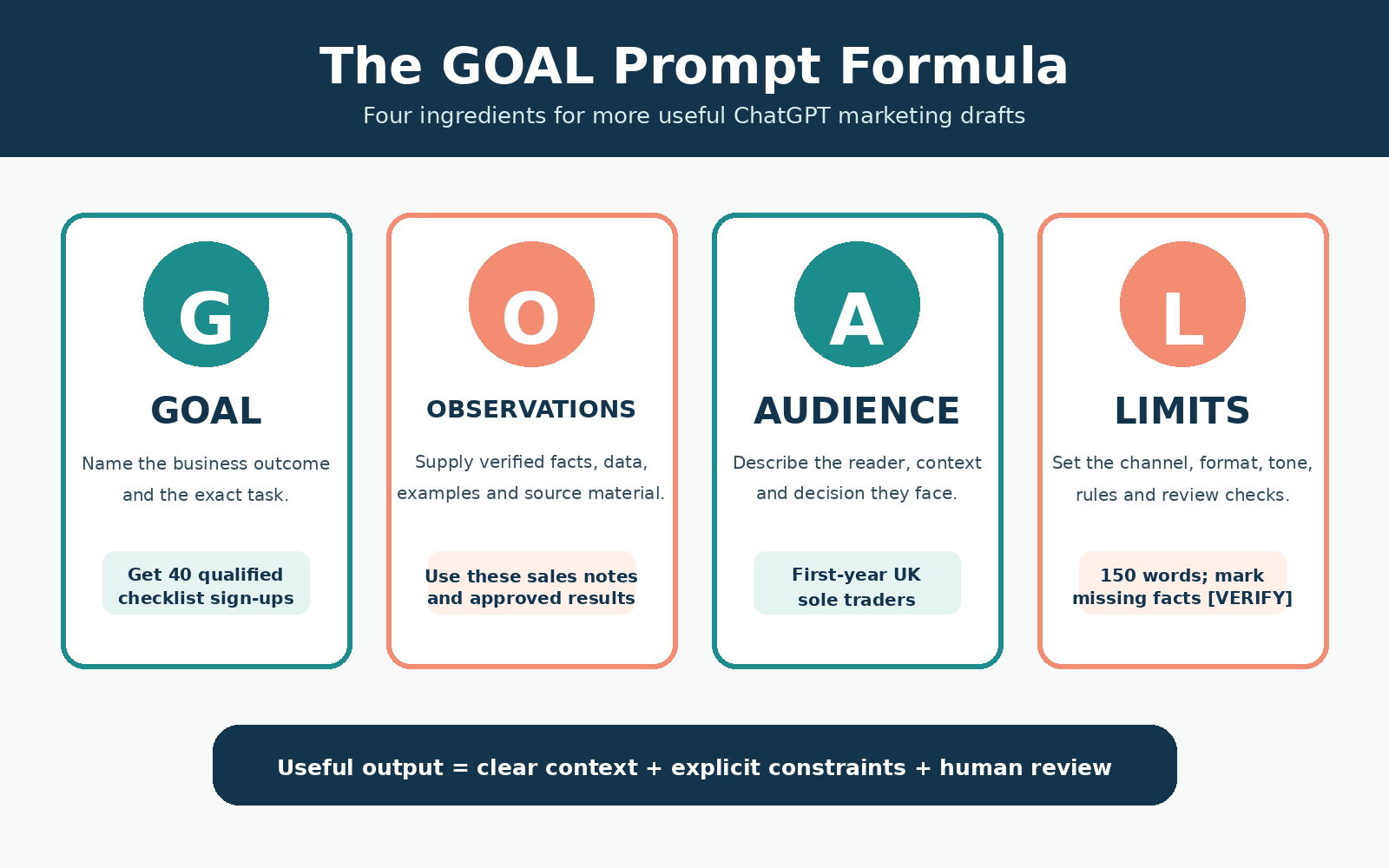
OpenAI’s prompting guidance recommends being clear and specific, refining iteratively, and naming the desired tone. The GOAL formula turns that advice into a compact marketing habit:
- G — Goal: What business outcome and task are you working on?
- O — Observations: What verified facts, examples, performance data, and source material matter?
- A — Audience: Who is this for, what do they know, and what decision are they making?
- L — Limits: What format, length, tone, channel rules, banned claims, and review checks apply?
Compare these two requests:
Weak: “Write a promotional email for our course.”
Useful: “Draft the first email in a three-email launch sequence for our live Excel course. The goal is registration from operations assistants who already know basic formulas but struggle with monthly reporting. Use the attached syllabus and two approved testimonials only. Write 120–160 words in a calm, encouraging tone. Include one subject line, preview text, one call to action, and a [VERIFY] marker for any missing fact. Do not use urgency or income claims.”
When you use ChatGPT for digital marketing with this amount of context, the first response becomes easier to review because the success conditions are visible.
Step 6: draft one core asset, then adapt it by channel
Do not ask for a blog post, email, ad, landing page, and ten social captions in one prompt. Create the core message first. Review the facts and angle. Then adapt it one channel at a time.
| Channel | What changes | Useful review question |
|---|---|---|
| Blog/SEO | Search intent, depth, structure, sources, internal links | Does this fully answer the reader’s actual question? |
| Subscriber context, subject line, one next action | Would the promise make sense without seeing the campaign? | |
| Professional context, strong opening, scannable point of view | Is there a real idea here, or only repackaged advice? | |
| Visual hook, concise caption, platform-appropriate action | Can the visual communicate before the caption is opened? | |
| Paid ad | Policy compliance, audience-offer fit, testable variants | Does the landing page deliver the exact same promise? |
| Landing page | Offer clarity, proof, objections, friction, one conversion | Can a first-time visitor explain the offer in ten seconds? |
For SEO content, start from reader intent, not keyword repetition. Use the phrase people search for where it clarifies the topic, then cover related questions naturally. Internal links should help the next step. For example, a reader who is new to the underlying technology may benefit from Artsians’ introduction to ChatGPT, while a freelancer can continue with the AI freelancing starter guide.
Step 7: edit in passes instead of saying “make it better”
A vague editing prompt often replaces one generic draft with another. Review in focused passes:
- Accuracy pass: list factual claims, numbers, names, dates, quotes, and product details that require verification.
- Audience pass: identify jargon, missing context, weak examples, and unanswered objections.
- Voice pass: compare the draft with approved writing samples and flag sentences that do not sound like the brand.
- Clarity pass: shorten long sentences, replace vague words, remove repetition, and improve transitions.
- Conversion pass: check whether the offer, proof, next step, and landing-page promise agree.
- Compliance pass: review platform rules, consent, disclosures, accessibility, and any legal requirements with the responsible person.
Add something only your business knows: a real customer question, an observed mistake, a photograph, a process detail, a product limitation, or an approved result. That is what makes content useful and distinctive. Swapping a few synonyms does not.
Step 8: analyze performance data and decide the next test
If data analysis is available, upload a clean CSV with only the fields needed. Define every column and the decision you want to make. For example:
Prompt: Analyze this campaign CSV. Each row is one email send. “Delivered” excludes bounces; “Clicks” are unique clicks; “Conversions” are completed trial sign-ups within seven days. First check for missing values and duplicates. Then calculate click rate and conversion rate by audience segment, compare week-over-week change, identify the three largest anomalies, and create one simple chart. Do not claim causation. Finish with two test ideas tied to the data.
Recalculate a sample manually. Check that percentages use the right denominator and that the date range matches your reporting window. A neat chart can still be built on the wrong definition.
Step 9: record what worked and turn it into a routine
Save the winning brief, prompts, approved examples, and final results in the same Project or team documentation. Note what changed between the AI draft and the published version. Over time, this becomes a practical playbook rather than a folder full of disconnected chats.
A beginner can use ChatGPT for digital marketing each week with a simple rhythm:
- Monday: review the goal, current data, and customer questions.
- Tuesday: plan and draft one core asset.
- Wednesday: verify, edit, and obtain the required approvals.
- Thursday: adapt for selected channels and schedule the work.
- Friday: review early signals, capture lessons, and choose the next test.
Copy-and-customize ChatGPT marketing prompts
Prompt for an audience-question map
I will paste anonymized sales notes and customer questions. Group them into: goals, frustrations, objections, decision criteria, and unanswered questions. Preserve short examples of the customer’s own wording. Do not invent demographics or motivations. Finish with five research gaps I should investigate before creating content.
Prompt for a one-page campaign plan
Create a one-page campaign plan from the context below. Include: objective, audience, insight, offer, primary message, channel roles, assets, owner, timeline, budget assumptions, key risks, and measurement plan. If a required fact is missing, ask me before drafting. Context: [paste verified brief].
Prompt for an SEO content outline
Build an article outline for the query “[primary query]” and an audience of [reader]. State the likely informational intent in one sentence. Propose a direct-answer introduction, logically ordered H2 and H3 sections, a practical example, one comparison table, common mistakes, and FAQs. Use the supplied research only. Label unsupported claims [SOURCE NEEDED]. Suggest three relevant internal-link opportunities based on this URL list: [paste URLs].
Prompt for social repurposing
Turn the approved article below into three LinkedIn posts for [audience]. Each post must teach one different idea from the source, open naturally, and include one practical takeaway. Keep each under 180 words. Do not add statistics, quotes, or examples that are not in the article. Avoid “game-changer,” “unlock,” “revolutionize,” and exaggerated claims. Article: [paste approved text].
Prompt for email subject-line testing
Write eight subject lines for this approved email. Create four clear-benefit options and four curiosity options. Keep each under 45 characters, avoid false urgency, and do not promise a result the email cannot deliver. For each line, explain the angle in five words or fewer. Then select two meaningfully different options for an A/B test.
Prompt for a fact-check list
Review this draft as a skeptical editor. Create a table with: exact claim, claim type, verification needed, best primary source, and risk if wrong. Include dates, product features, prices, legal statements, statistics, quotations, comparisons, and named organizations. Do not attempt to “fix” uncertain claims; mark them for a human decision.
Practical example: a one-week local campaign
If you use ChatGPT for digital marketing with these guardrails, the process can stay quick without becoming careless. The following fictional example shows how the responsibilities fit together.
Let us return to Sara’s fictional bakery. The goal is 25 weekday office-box pre-orders within a three-kilometre delivery area. She has product photographs, verified prices, ingredient information, delivery times, five approved customer comments, and a simple order page.
- She adds those facts to a campaign brief and tells ChatGPT never to invent flavors, availability, or testimonials.
- She asks for three campaign ideas and selects “Make Tuesday meetings better.”
- She requests a landing-page outline, one email, two social posts, and a photo shot list—one task at a time.
- She checks every price, allergen statement, delivery boundary, and customer quote.
- She rewrites the opening in her usual friendly voice and adds a real note about ordering before Monday at noon.
- She publishes with a unique order code and measures visits, completed orders, average order value, and repeat orders.
Notice what ChatGPT did not do: choose the commercial goal, confirm food-safety language, take the photographs, approve the offer, or decide whether the campaign was profitable. The workflow is efficient because responsibility remains clear.
Seven beginner mistakes to avoid
- Starting with an empty prompt: without an audience, goal, proof, or constraints, the response defaults to broad internet-style advice.
- Publishing the first draft: a fluent answer can still contain false details, weak reasoning, or an unsuitable tone.
- Creating before researching: content based on imagined customer pain points often misses real buying questions.
- Asking for every channel at once: the message becomes inconsistent, and channel-specific details disappear.
- Uploading too much data: share the minimum authorized information required and follow applicable privacy rules.
- Measuring activity instead of outcomes: more posts are not a result. Track qualified visits, leads, orders, retention, or another defined business metric.
- Trying to hide AI involvement: quality comes from truthful inputs, human judgment, original evidence, careful editing, and accountability—not from tricks intended to beat a detector.
AI-detection tools are not a reliable quality standard and can produce false positives. The defensible goal is content that is accurate, useful, original, and consistent with your publishing policy. If AI assistance requires disclosure in your organization, client agreement, platform, or jurisdiction, disclose it appropriately.
How to keep ChatGPT-assisted content natural and trustworthy
If your draft sounds generic, the problem is usually upstream. It lacks specific observations. Add material that only a responsible operator could supply: a real question heard on a sales call, the reason a product has a limitation, a decision your team changed after reviewing data, or a step customers often misunderstand.
Then edit for voice:
- Replace vague openings with the reader’s actual situation.
- Vary sentence length, but keep the meaning easy to follow.
- Delete empty transitions and exaggerated adjectives.
- Use contractions if your brand uses them.
- Keep useful caveats instead of pretending every tactic works for everyone.
- Prefer one concrete example over five generic claims.
- Read the draft aloud; awkward rhythm is easier to hear than to see.
That approach makes the writing feel lived-in because the thinking is grounded in real work. It also gives readers something worth remembering.
A 30-day beginner plan to use ChatGPT for digital marketing

Week 1: set the foundation
- Choose one goal, audience, offer, and primary conversion.
- Create the one-page marketing brief and gather approved brand examples.
- Set up a Project or organized chat workflow.
- Write your standing rules for facts, privacy, tone, and [VERIFY] markers.
Week 2: learn from customers
- Anonymize and organize customer questions, reviews, and sales notes.
- Use web search for current facts, then open and verify the primary sources.
- Map discovery, consideration, and action questions.
- Choose one campaign idea and define its success metric.
Week 3: create and review
- Draft one core asset using the GOAL prompt formula.
- Run accuracy, audience, voice, clarity, conversion, and compliance reviews.
- Add first-hand examples, proof, and useful internal links.
- Adapt the approved message to no more than two supporting channels.
Week 4: publish, measure, and improve
- Complete human approval and publish the campaign.
- Check tracking and collect baseline performance.
- Analyze results without confusing correlation with causation.
- Document the winning prompt, edits, and next test.
After 30 days, expand only if the process is producing useful work. You might add another channel, a more advanced analysis, or a repeatable content series. You do not need a complicated automation stack to begin.
Final pre-publication checklist
| Check | Pass condition |
|---|---|
| Goal | The asset supports one named business outcome |
| Audience | The draft addresses a defined reader and decision |
| Facts | Names, dates, prices, features, quotes, and statistics are verified |
| Original value | The piece includes genuine insight, evidence, or a useful example |
| Voice | The writing matches approved examples and avoids generic filler |
| SEO | Intent is satisfied; title, introduction, headings, metadata, links, and image alts are descriptive |
| Accessibility | Headings, link text, image alternatives, tables, and contrast are reviewed |
| Privacy | No unauthorized personal, client, or confidential data appears |
| Compliance | Claims, disclosures, consent, and platform rules have the required approval |
| Measurement | The conversion, tracking method, baseline, and review date are defined |
Frequently asked questions
Can a complete beginner use ChatGPT for marketing?
Yes. Start with a low-risk task such as organizing customer questions, outlining one article, or drafting variations from approved copy. Give clear context, verify facts, and keep a person responsible for the final decision and publication.
How do I use ChatGPT for digital marketing for free?
You can begin with the ChatGPT Free plan and a simple text workflow, subject to current limits and feature availability. Use one chat or Project for a focused campaign, provide a short brief, and work through research, planning, drafting, review, and measurement in small steps.
What is the best first ChatGPT marketing task?
Choose a task that is easy to verify and already part of your work. Turning anonymized customer questions into a content outline is a strong first project because the source material is real and the output can be reviewed before anything is published.
Can ChatGPT create an entire marketing strategy?
It can help organize information, ask useful questions, compare options, and draft a plan. A responsible person still needs to validate the market assumptions, choose the positioning, approve the budget, check compliance, and own the result.
Can I use ChatGPT for SEO content?
Yes, as an assistant for intent analysis, research organization, outlines, drafts, metadata, internal-link ideas, and editing. Verify sources, add original experience, avoid keyword stuffing, and make sure the final page genuinely resolves the reader’s question.
Can ChatGPT analyze marketing data?
When data analysis is available, ChatGPT can help clean files, calculate metrics, compare segments, visualize trends, and summarize findings. Define each field, inspect missing data, check formulas, and avoid claiming that one factor caused a result unless the study design supports it.
Should I paste customer data into ChatGPT?
Share only information you are authorized to use and only what the task needs. Remove direct identifiers where possible and follow your organization’s privacy, security, contractual, retention, and regulatory requirements. Ask your workspace administrator when you are unsure.
Will Google penalize ChatGPT-assisted content?
Search performance depends on the usefulness, accuracy, originality, and overall quality of the page—not simply on which tool helped draft it. Avoid scaled, low-value pages and deceptive practices. Apply human review, add real expertise, and publish for the reader’s intent.
How can I make a ChatGPT draft sound like my brand?
Provide approved writing samples, define specific voice traits, name words or claims to avoid, and add real observations from your business. Edit in separate accuracy, audience, voice, and clarity passes. A vague request to “humanize” text is less useful than concrete examples and editorial judgment.
The practical takeaway
The best way to use ChatGPT for digital marketing is to make the work smaller and more accountable. Start with one outcome. Supply verified context. Ask for a reviewable draft. Check every important claim. Add the experience only your business can contribute. Publish through the same approval process you would use for any other marketing work.
Do that for one campaign over 30 days, and you will learn more than you would by collecting hundreds of clever prompts. The advantage is not that ChatGPT writes everything for you. It is that you can move from question to draft to evidence-backed decision with less friction—and still keep a human responsible for the result.
Comments