
 AI-generated illustrative business scene; the interface is conceptual and does not show live keyword data.
An AI assistant gives you 100 keyword ideas in seconds. The list looks convincing, so you choose one phrase, request a full article, and publish it. Weeks later, the page has few impressions and no useful inquiries. The problem is not simply that AI was involved. The problem is that an idea was mistaken for verified demand, a fluent draft was mistaken for a useful page, and no measurement plan connected publication with a business decision.
A safer workflow gives AI a bounded job at each stage. It begins with real customer evidence, validates keywords with current data and search results, adds original human knowledge, and ends with measurement. This guide shows that complete process without pretending that a general AI response contains live keyword volume or guaranteed ranking advice.
What does using AI for SEO actually mean?
AI-assisted SEO uses a language model or another AI feature to help complete defined tasks inside a wider search-optimization process. The tool may organize information, propose patterns or improve wording. The process still needs current evidence, business context and a reviewer who can reject the output.
Keep these responsibilities separate:
| SEO task | Useful AI assistance | What still needs verification |
|---|---|---|
| Topic research | Expand supplied customer questions into related themes. | Whether the theme matters to the audience and business. |
| Keyword research | Group, label and deduplicate phrases. | Current demand, location, competition and data source. |
| Search intent | Suggest what a searcher may need. | What the current results actually show. |
| Content brief | Organize questions, headings and evidence gaps. | Unique angle, source quality and editorial priority. |
| Drafting | Create or revise bounded sections from an approved brief. | Facts, experience, quotations, rights and usefulness. |
| On-page SEO | Propose titles, descriptions and link candidates. | Accuracy, natural language, real URLs and implementation. |
| Reporting | Summarize checked exports and surface questions. | Definitions, missing data, causation and final decisions. |
Google’s guidance on generative AI content says AI can be useful for research and structure, while warning that generating many pages without adding value may violate its scaled-content policy. The useful dividing line is not “human versus AI.” It is whether the finished work is accurate, original enough to help, and created for readers rather than ranking manipulation.
What you need before starting
AI cannot recover context that the business has never documented. Assemble a small evidence pack before requesting keywords or outlines:
- Audience: the customer group, location, language and problem the page will serve.
- Business goal: the inquiry, sale, signup or support outcome the content should assist.
- Customer evidence: real questions from calls, email, forms, reviews or support—de-identified when necessary.
- Website inventory: existing pages, their URLs, purpose and current performance.
- Search evidence: Search Console queries and an approved current keyword-data source.
- Editorial evidence: official documentation, original examples, subject knowledge and claims needing expert review.
- Publishing controls: the person responsible for SEO, factual accuracy, technical changes and final approval.
Do not paste personal customer information, private contracts, credentials or confidential business data into an unapproved tool. Use aggregated questions or fictional examples until the organization has reviewed the product, account settings and permitted data.
Step 1: build seed topics from real customer problems
A seed topic is a broad starting point, not yet a target keyword. Begin with language customers already use. Sources can include sales questions, site-search terms, support tickets, Search Console queries, reviews, community discussions and objections recorded by staff.
For example, a local home-cleaning company may hear, “Do I need to provide cleaning supplies?” That single question could lead to topics about what is included, preparing a home, eco-friendly products and comparing service types. AI can expand those connections, but the original customer question anchors the work in a real need.
Ask the tool to separate supplied evidence from its suggestions. If it cannot cite a source for demand, label the output idea for validation. That simple label prevents a brainstorm from becoming a fake research report.
Step 2: generate and validate keyword ideas
Give AI your seed topics and ask it to organize possible phrases by meaning. A useful output may distinguish a primary phrase, close variants, related questions and terms that belong on a different page. It should not attach invented monthly searches, difficulty scores or rankings.
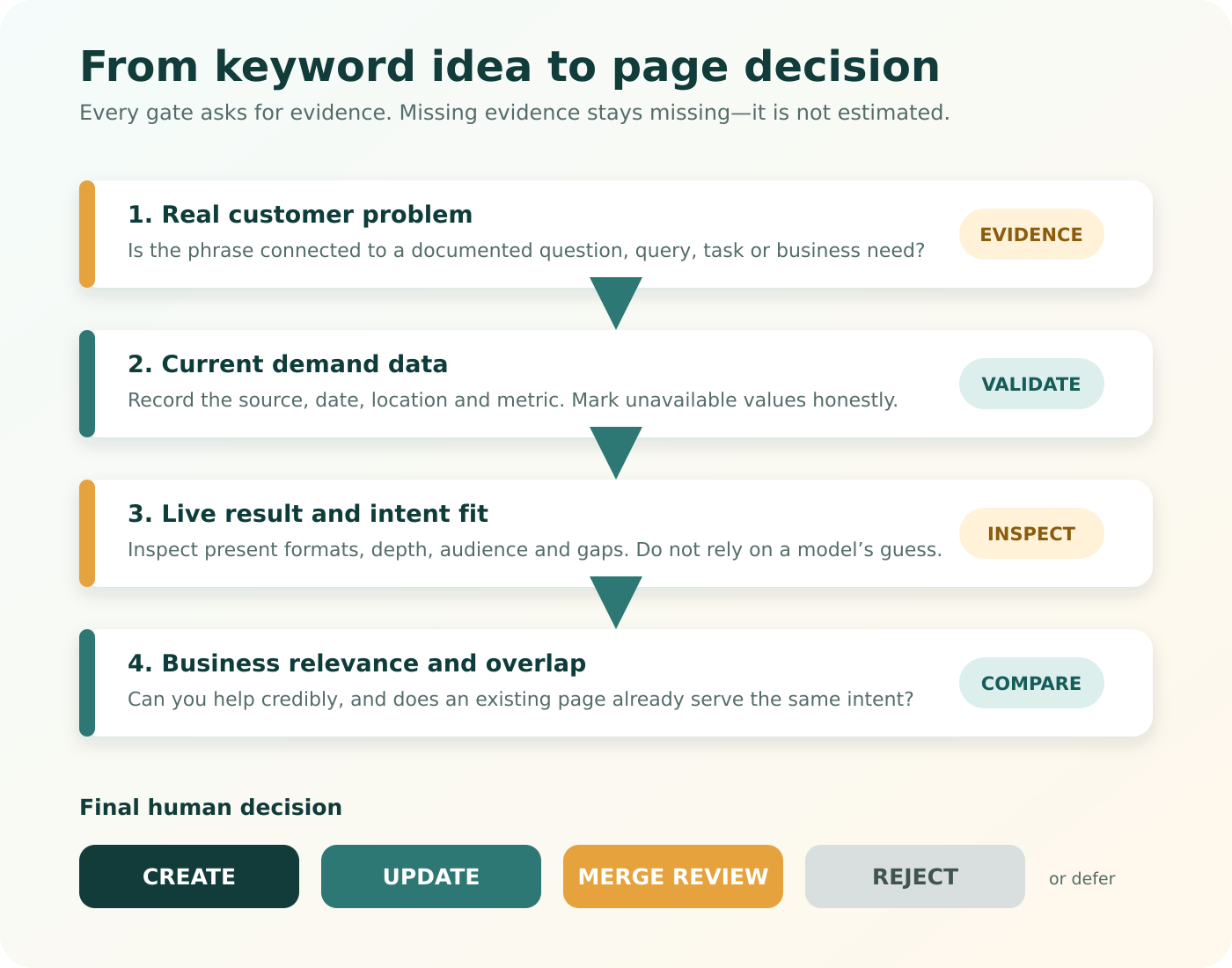
Validate the list in a worksheet:
| Field | Question to answer |
|---|---|
| Keyword | What exact phrase or query theme is being considered? |
| Evidence source and date | Where did the current query or demand data come from? |
| Search intent | What job is the searcher trying to complete? |
| Business relevance | Can the business genuinely help with this need? |
| Existing page | Does a current page already address the same intent? |
| Expected format | Guide, service page, comparison, product page or another format? |
| Decision | Create, update, merge, redirect for review, or reject? |
Search Console is especially useful for queries where the site already receives impressions. Its Performance report provides clicks, impressions, click-through rate and average position, with dimensions such as query and page. It does not prove the total market size for every possible keyword. Keep the scope of each data source clear.
Step 3: inspect search intent
Search intent describes the task behind a query. A practical editorial framework uses four broad labels: informational, commercial investigation, transactional and navigational. These labels help discussion, but the live results remain the evidence.
Review the current results manually and record:
- whether guides, service pages, product pages, videos or tools dominate;
- the audience level and expected depth;
- recurring questions and important subtopics;
- whether freshness, local relevance or first-hand experience appears important;
- what existing results leave unclear or unsupported.
Do not instruct AI to “analyze the current SERP” unless the product is actually retrieving current results and you can inspect its sources. A safer method is to supply your observations or exported headings, then ask the model to organize them. The reviewer still decides what the pattern means.
Step 4: group keywords into topic clusters
A topic cluster maps related needs to the smallest useful set of pages. The objective is not to create a page for every variation. It is to give each distinct search intent a clear destination and connect related pages with descriptive internal links.
For a hypothetical bookkeeping service, “small-business bookkeeping guide” could be a broad educational page. “Monthly bookkeeping service” belongs on a service page, while “bookkeeping checklist for year end” may deserve a supporting guide. Close variations that need the same answer should normally stay together.
Before approving a new article, compare its proposed primary intent with the current inventory. If two pages would answer the same question for the same reader, update or merge may be better than publishing another competing page. Do not automate redirects or deletion; those changes require a technical review of links, traffic and business value.
Step 5: create an evidence-based content brief
The brief is the control point between research and writing. It should state what is known, what must be created, and what remains uncertain. Include:
- target reader, location and experience level;
- primary problem and desired next action;
- validated keyword theme and observed intent;
- page type and unique angle;
- questions the page must answer;
- official sources, original evidence and expert input;
- claims that require verification;
- existing pages to link from and to;
- visuals that explain something prose cannot;
- success measure and review date.
AI can transform approved notes into a consistent brief. Require it to mark unsupported items as verification required. If the model fills gaps with plausible numbers, quotations or product features, remove them rather than polishing them into the draft.
Step 6: write useful content with AI assistance
A reliable sequence is human direction, AI-assisted organization, human evidence, AI-assisted editing and final human approval. The person does not need to type every sentence, but someone must own what the page claims.
- Define the central answer. Write one or two sentences the page must make clear.
- Build the structure. Use the brief to create a logical outline, not headings copied from competitors.
- Add original value. Supply genuine examples, tested procedures, screenshots, diagrams or expert explanation.
- Draft in sections. Review each section before the next one compounds an error.
- Verify every claim. Open the cited source, check the date and remove unsupported statements.
- Edit for the reader. Reduce repetition, define jargon and make the next step clear.
Google’s people-first content guidance asks whether content provides original information, reporting, research or analysis and whether it serves an existing audience. A generic summary that could appear on hundreds of sites is a weak reason to publish, even when every sentence is grammatically correct.
Step 7: complete on-page optimization
On-page SEO should make the page clearer, not make the writing mechanical. Review:
- Title and H1: accurate, distinct and aligned with the main need.
- URL: short, stable and descriptive.
- Opening: confirms the problem and scope without delaying the answer.
- Headings: reflect the article’s actual structure.
- Meta description: a truthful, useful summary rather than a ranking promise.
- Links: crawlable destinations with meaningful anchor text.
- Images: purposeful visuals, useful surrounding text and accurate alt text.
- Mobile experience: readable paragraphs, scrollable tables and accessible controls.
- Technical signals: intended canonical, indexability and valid structured data where appropriate.
AI can propose alternatives, but Google may create title links from several page signals and may generate snippets from page content. Its title-link guidance therefore supports consistency rather than treating one generated title as a fixed display. Avoid repeated keywords; Google’s SEO Starter Guide notes that excessive repetition is tiring for users and can become keyword stuffing.
Step 8: find internal-link opportunities
Give AI an approved inventory containing each published URL, title and one-sentence purpose. Ask for candidate links with the source page, destination page, suggested anchor and the paragraph where the connection makes sense. Then check every recommendation.
A strong link helps the reader continue a task. “Compare practical AI marketing tools” is more informative than “click here.” Google’s link guidance explains that descriptive internal anchor text helps people and Google understand pages and discover related content.
In this article, readers who need a broader marketing workflow can use the Artsians guide to using ChatGPT for digital marketing. Those choosing software can compare AI marketing tools for small businesses. The separate guide to ChatGPT Search visibility covers how a business website may become easier for AI-powered search systems to retrieve and recommend; it is not the same task as using AI to perform SEO work.
Step 9: publish, measure and improve
Record the publication date, target intent, baseline, conversion action and review date. Do not judge success from one manual search. Results vary by location, device and context, while SEO outcomes often take time.
| Metric | Useful question |
|---|---|
| Indexed status | Can the page currently be included in Google Search? |
| Impressions | Is the page appearing for relevant searches? |
| Clicks | Are searchers choosing the result? |
| CTR | What share of recorded impressions produced clicks? |
| Average position | How is the top result from the site positioned on average within this report scope? |
| Engaged visits | Do visitors interact meaningfully after arriving? |
| Conversions | Does the page assist the defined business outcome? |
| Assisted internal journeys | Do readers continue to relevant tools, guides or service pages? |
Google recommends focusing more on trends in impressions and clicks than on position alone. Export a consistent date range, preserve the metric definitions, and let AI summarize only the checked data you provide. Ask it to separate observations from hypotheses. A traffic increase after a revision does not by itself prove which change caused it.
The complete AI-assisted SEO workflow
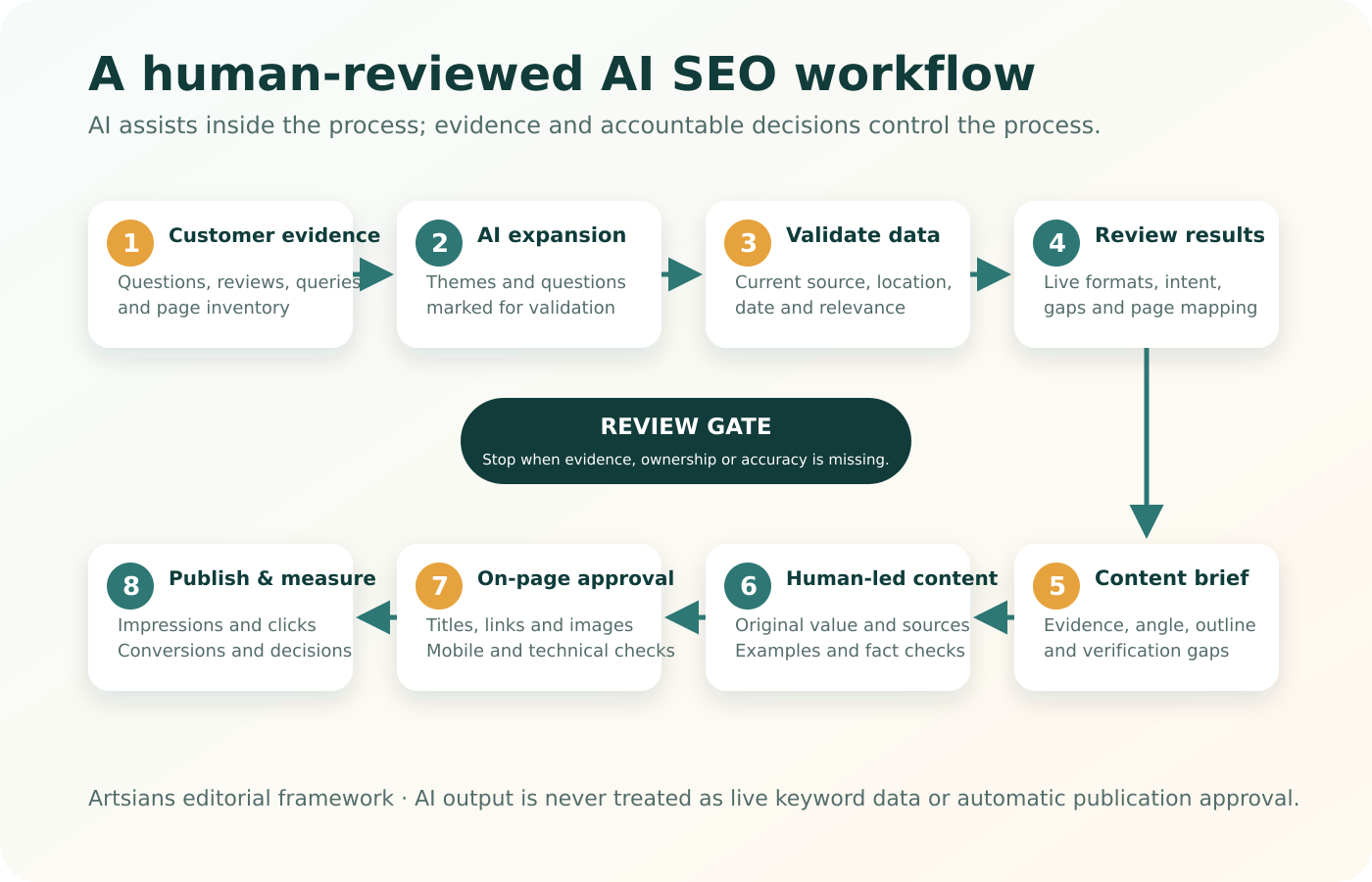
- Collect real customer questions and existing performance evidence.
- Use AI to expand themes and organize ideas.
- Validate possible keywords using current data and dates.
- Inspect live results and map each distinct intent to one page.
- Create a brief that separates evidence from assumptions.
- Write with original knowledge, verified sources and visible limitations.
- Approve titles, links, images, technical signals and mobile presentation.
- Publish as part of a measured content system; review, improve or consolidate.
Worked example: a local home-cleaning company
Hypothetical example: the company, questions and decisions below are illustrative, not Artsians client results.
Customers often ask whether they must provide supplies. The marketer records the exact question and supplies policy. AI expands the topic into “does a house cleaner bring supplies,” “what is included in house cleaning,” and several related preparation questions. No volume values are requested.
Current keyword evidence and live results suggest that the main need is informational. The website already has a service page explaining packages but no clear preparation guide. Instead of creating multiple near-identical articles, the marketer plans one guide: “Do House Cleaners Bring Their Own Supplies? What to Expect.” The service page will receive a short clarification and link to the guide.
The brief requires the company’s actual policy, a checklist for homeowners, exceptions for allergies and pets, and a clear service-area note. AI organizes the outline and drafts the checklist. The operations manager verifies every item and removes a suggested “industry standard” claim that has no source. The editor adds original photos of the permitted supply kit and descriptive alternative text.
After publication, the marketer records relevant Search Console queries, clicks to the service page and completed quote requests. If the guide earns impressions but visitors do not continue, the team reviews the opening, service connection and next action. If another existing page begins receiving the same query set, the team evaluates consolidation rather than publishing more variants.
Eight reusable AI prompts for SEO
Replace the brackets with approved information. These prompts request assistance, not permission to publish or make technical changes.
1. Customer-problem discovery
“You are organizing supplied customer evidence for [BUSINESS TYPE] serving [AUDIENCE AND LOCATION]. Using only [DE-IDENTIFIED QUESTIONS, REVIEWS OR CALL NOTES], group recurring problems and the exact language customers use. Separate evidence from your suggestions. Do not invent demographics, demand, search volume or quotations. Return a table with problem, evidence, possible seed topic and missing information.”
2. Seed-topic expansion
“Expand these validated seed topics: [TOPICS]. Suggest related questions, comparisons and task stages for [TARGET READER]. Label every output ‘idea for validation.’ Do not provide search volume, keyword difficulty, rankings or trend claims. Flag phrases that may require a separate service or product page rather than an article.”
3. Keyword classification
“Organize this keyword export without changing its values: [KEYWORDS WITH SOURCE, DATE AND METRICS]. Group close variants, identify likely intent, and suggest create, update, merge or reject for review. Preserve missing data as ‘unavailable.’ Do not calculate or estimate absent metrics. Explain uncertain classifications.”
4. Search-intent analysis
“Using these manually collected current search-result observations [PAGE TYPES, HEADINGS, DATES, FEATURES], identify the dominant reader tasks and formats. Separate observation from inference. Note conflicting patterns and gaps a genuinely useful page could address. Do not claim live search access or ranking factors.”
5. Topic-cluster map
“Using this published content inventory [URL, TITLE, PURPOSE] and validated keyword groups [LIST], map each distinct intent to the smallest useful set of pages. Flag possible cannibalization. Recommend create, update or merge for human review, but do not recommend deletion or redirects without a technical audit.”
6. Evidence-based content brief
“Create a content brief for [TOPIC] serving [READER]. Use [VALIDATED INTENT], [BUSINESS GOAL], [OFFICIAL SOURCES] and [ORIGINAL EVIDENCE]. Include central answer, unique angle, questions, proposed structure, visual purpose, internal links and CTA. Mark every unsupported claim ‘verification required.’ Do not invent experience, statistics or quotes.”
7. On-page and internal-link review
“Review [DRAFT] against [APPROVED BRIEF]. Suggest accurate title, H1, meta-description, heading and internal-link alternatives. Use only destinations in [PUBLISHED URL INVENTORY]. Explain the reader benefit of each link. Flag missing evidence, repetition and unnatural keyword use. Do not guarantee display, indexing or rankings.”
8. Performance and refresh analysis
“Analyze this checked export for [PAGE AND DATE RANGE]: [DATA]. Preserve definitions and show calculations. Separate observations, hypotheses and missing data. Compare with [BASELINE] only where scopes match. Suggest three questions to investigate and possible update tests; do not claim causation or predict rankings.”
Common AI SEO mistakes
- Invented keyword metrics: fluent estimates are not a current data source.
- Unverified search intent: a model’s guess cannot replace reviewing present results.
- One page per variation: near-duplicate pages can confuse readers and divide maintenance.
- Competitor rewriting: rearranging existing pages adds little original value.
- Manufactured experience: never claim tests, clients, credentials or results that did not occur.
- Keyword stuffing: repeated phrases reduce readability and can violate spam policies.
- Uncontrolled technical changes: redirects, canonicals, deletions and robots rules require review.
- Broken internal links: an invented slug helps nobody.
- Activity-only reporting: page count is not a business outcome.
- Automated publication: a human approval gate is cheaper than repairing a scaled error.
AI SEO quality-control checklist
| Area | Required checks |
|---|---|
| Research | Customer need, source dates, keyword evidence and live-result observations recorded. |
| Accuracy | Claims, quotes, calculations, product details and links opened and verified. |
| Originality | Page adds genuine examples, decisions, evidence or explanation beyond a generic summary. |
| Intent | Format and depth help the reader complete the observed task. |
| On-page | Title, H1, opening, headings, URL, description, images and anchor text are accurate. |
| Technical | Indexability, intended canonical, schema, mobile tables and destinations checked. |
| Trust | Author, limitations, source trail and update responsibility are clear. |
| Measurement | Baseline, conversion, publication date and review date recorded. |
Frequently asked questions
Can AI perform SEO automatically?
AI can assist with research organization, clustering, outlines, editing and report summaries, but it cannot responsibly own the entire SEO process. Current search results, business priorities, factual accuracy, technical implementation and publication approval still require reliable data and accountable human review. Begin with one bounded task and keep an approval gate before anything is published.
Can ChatGPT conduct keyword research?
ChatGPT can expand seed topics, group phrases, suggest questions and organize a keyword list you provide. Unless a connected product is retrieving current data, do not treat its estimates as live search volume, keyword difficulty or rankings. Validate ideas with current search results, Search Console and an approved keyword-data source before choosing a target.
Is AI-generated content safe for SEO?
AI involvement alone is not the deciding issue. Google emphasizes useful, reliable content and warns that generating many pages without value can violate its scaled-content policy. Review every draft, verify claims, add relevant original knowledge and publish for readers rather than to manipulate rankings. No tool or prompt can guarantee indexing, visibility or traffic.
Can AI provide accurate keyword search volume?
A general AI response should not be treated as a current keyword-volume report. Search demand varies by location, language, device, season and data provider. Ask AI to organize values exported from an approved source, keep the source and date attached, and mark missing values as unavailable instead of allowing the model to estimate them.
How can AI improve on-page SEO?
AI can prepare title alternatives, summarize a page for a meta-description draft, identify unclear headings, suggest internal-link candidates and check whether a brief was covered. A reviewer should confirm that every suggestion accurately represents the page, reads naturally, links to a real destination and improves the reader’s experience.
Does Google penalize AI-written content?
Google’s published guidance focuses on content quality and purpose, not a blanket penalty for using AI. Using automation primarily to manipulate rankings or producing scaled pages without added value can violate spam policies. Treat AI as an editorial aid, preserve human accountability and evaluate the finished page against the same usefulness and accuracy standards as any other content.
What should humans check before publishing AI-assisted SEO content?
Check the reader need, search intent, factual support, original contribution, examples, quotations, links, permissions, title, headings, image alternatives, mobile formatting and next action. Confirm that uncertain claims are removed or labelled and that the page does not compete unnecessarily with an existing page on the same website.
Which SEO tasks should not be fully automated?
Do not fully automate publication, deleting or redirecting pages, changing canonical tags, making legal or medical claims, selecting strategy from unverified data or sending outreach under a person’s identity. These actions can create lasting technical, reputational or compliance problems. Require an authorized person to review the evidence and approve the change.
Use AI to strengthen the process, not bypass it
Start with a real customer problem. Let AI expand and organize ideas, then validate them with current evidence. Inspect the search results, build one useful page, verify every claim and keep a person responsible for the final technical and editorial decisions. After publication, measure trends and business outcomes before scaling the workflow.
Artsians readers can use the SEO and content tools to check draft length, repeated phrases and search-copy presentation. Use those checks as editorial support, not as a score that promises rankings.
Sources and further reading
- Google Search Central: guidance on generative AI content
- Google Search Central: helpful, reliable, people-first content
- Google Search Central: spam policies
- Google Search Central: SEO Starter Guide
- Google Search Central: link best practices
- Google Search Central: title links
- Google Search Central: image SEO
- Google Search Console: Performance report
Comments