
 AI-generated illustrative business scene; the screen contains conceptual campaign graphics rather than real customer data.
When you use AI for email marketing without a clear brief, the tool may return polished copy in seconds. However, the message can sound like every other promotion in the inbox. It may also invent urgency, miss the customer’s real concern and use a discount that was never approved.
The problem is not that AI wrote a draft. Instead, the problem is that it received no evidence, limits or review process. A better workflow gives AI a clear role while the business keeps control of permission, customer data, offers and final sending decisions.
Before you use AI for email marketing: protect permission, data and deliverability
AI can speed up email work, but it does not change the rules that apply to marketing messages. Therefore, check permission and suppression records before you draft. In addition, keep promotional and transactional messages clearly separated.
Confirm who may receive the campaign
Email rules vary by country, recipient type and message purpose. For example, the UK Information Commissioner’s Office says unsolicited marketing to individual subscribers normally needs consent or a valid soft opt-in. It also requires a valid contact address for opting out. Meanwhile, the US Federal Trade Commission requires covered commercial email to use accurate sender information, non-deceptive subject lines and a working opt-out method.
This article offers general marketing guidance, not legal advice. Consequently, confirm the requirements for each market before sending.
Prepare the sender before scaling
Good copy cannot repair weak sender setup. Gmail’s current sender guidance requires authentication and low spam rates. Moreover, senders that deliver more than 5,000 messages a day to Gmail accounts face added requirements, including DMARC alignment and one-click unsubscribe for marketing messages.
Before a live campaign, test the sending domain, links, reply address, unsubscribe process and mobile layout. Also confirm that the email platform suppresses people who have opted out.
Set clear AI email marketing data rules
Customer data should not become prompt material by default. Australian government guidance for small businesses recommends defining what information staff may share with AI tools, reviewing vendor data practices and keeping human oversight. Therefore, use fictional, aggregated or de-identified inputs whenever real identities are unnecessary.
| Task | AI assistance | Human responsibility |
|---|---|---|
| Campaign planning | Organize goals, ideas and objections. | Choose the audience, offer and legal basis. |
| Copywriting | Prepare drafts and variations. | Verify every claim, link and commitment. |
| Personalization | Adapt approved templates to permitted segments. | Protect data and prevent intrusive assumptions. |
| Automation | Suggest sequence structure and timing questions. | Approve triggers, stop rules and suppression logic. |
| Analysis | Summarize checked campaign exports. | Interpret context and decide what to test next. |
Five practical ways to use AI for email marketing
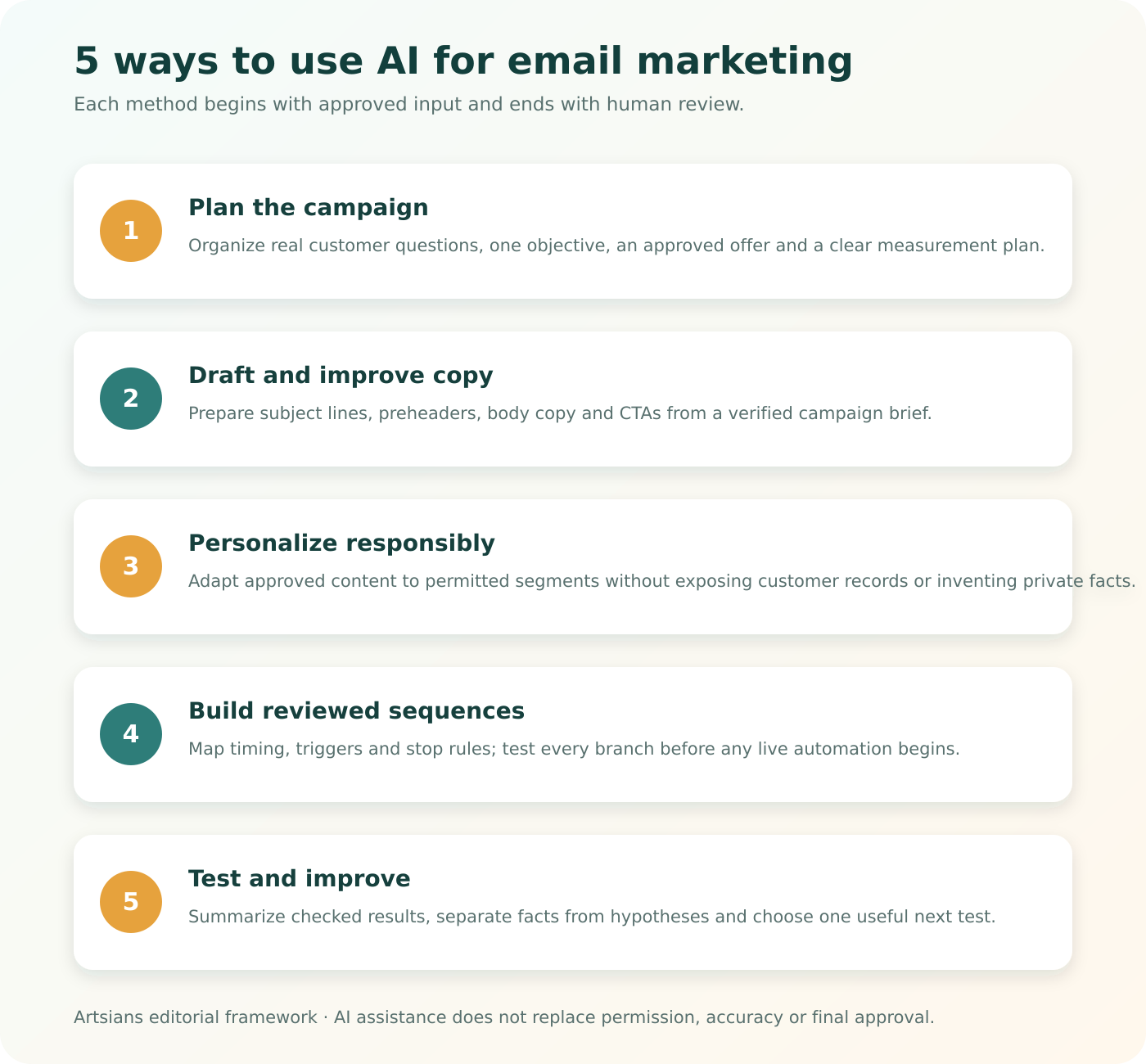
1. Plan AI email marketing campaigns from real customer needs
First, use AI to organize evidence you already have. Useful inputs include de-identified sales questions, support themes, past campaign lessons and approved product information. Because the source material is real, the plan is less likely to rely on a fictional customer persona.
Turn evidence into a focused brief
Ask AI to group the supplied questions into needs, objections and decision stages. Then choose one audience and one outcome. For example, a campaign may help new subscribers choose a product category rather than pushing an immediate discount.
A strong brief includes the audience, objective, offer, proof, tone, exclusions, next action and measurement plan. However, AI should label missing information instead of inventing it.
Copy-ready AI email marketing planning prompt
“Using only this approved information [BUSINESS, AUDIENCE, CUSTOMER QUESTIONS, OFFER AND LIMITS], create an email campaign brief. Include the reader’s main need, campaign objective, central message, evidence required, CTA and measurement plan. Separate supplied facts from assumptions. Do not invent customer research, urgency, prices or results.”
2. Draft and improve AI email marketing copy faster
Next, use AI for email marketing drafts rather than requesting one “perfect” email. Ask for a subject line, preheader, opening, body, CTA and plain-text version. In addition, specify the reading level, length and brand voice.
Generate variations with a reason
Variations should test a real question. For instance, one subject line can emphasize a practical benefit while another emphasizes the problem being solved. By contrast, five random alternatives create noise without a useful testing idea.
Review the draft for deceptive urgency, unsupported claims and vague CTAs. Also check that the subject line matches the email body. The FTC specifically warns against deceptive subject lines in covered US commercial email.
Copy-ready AI email marketing writing prompt
“Draft one marketing email from this approved brief [BRIEF]. Provide two subject lines that test different truthful angles, one preheader, body copy under [WORD LIMIT], one CTA and a plain-text version. Use [BRAND VOICE]. Do not add discounts, deadlines, testimonials, guarantees or facts that are not supplied. Finish with a reviewer checklist.”
For a wider drafting workflow, see the Artsians guide to using ChatGPT for digital marketing.
3. Personalize AI email marketing messages without becoming intrusive
Personalization is useful when it makes an email more relevant. However, inserting a first name into generic copy adds little value. A better approach changes the content according to a permitted need, preference or stage.
Start with safe segments
Use broad, approved segments such as new subscribers, recent customers or people who selected a stated topic preference. Meanwhile, avoid sensitive inferences about health, finances, religion or family circumstances unless the organization has a clear lawful and ethical basis.
Do not paste a customer list into a public AI chat. Instead, provide a fictional segment description or use an approved system with reviewed data controls. As a result, the model can adapt the message without seeing individual records.
Copy-ready AI email marketing personalization prompt
“Adapt this approved email [EMAIL] for these permitted segments [SEGMENT DESCRIPTIONS]. For each version, change only the opening, example and CTA where relevance requires it. Keep the offer and factual claims unchanged. Do not infer personal characteristics or mention data the recipient did not knowingly provide.”
4. Build AI email marketing sequences with human approval
You can use AI for email marketing sequences across several messages. For example, a welcome series may introduce the brand, answer a common question, provide proof and invite a next step. Still, sequence design needs more than copy.
Define triggers and stop rules
Specify what starts the sequence, how long it waits and what stops it. A purchase, reply, unsubscribe or complaint should trigger the correct change. In addition, promotional content should not be inserted into a message that the business incorrectly labels as purely transactional.
Test the automation with internal addresses before launch. Then verify every branch, link and fallback. Finally, assign a person to monitor errors and pause the sequence when the offer changes.
Copy-ready AI email marketing sequence prompt
“Design a [NUMBER]-email sequence for [AUDIENCE] after [PERMITTED TRIGGER]. Use these approved messages and offers [INPUT]. For each email, provide purpose, timing question, subject idea, central message and CTA. Add human-review gates, suppression checks and stop conditions. Do not assume consent or activate sending.”
5. Test and improve AI email marketing performance
Finally, use AI for email marketing analysis after checking the campaign export. Provide dates, metric definitions and the exact versions tested. Otherwise, the model may compare numbers that do not share the same audience or period.
Test one meaningful variable
Choose a clear hypothesis before sending. For example, test whether a benefit-led subject line produces more clicks from the same eligible audience than a question-led subject line. Keep the offer, sender and send window as consistent as practical.
Clicks, conversions, unsubscribes and spam complaints often provide more actionable context than opens alone. Therefore, connect email activity with the business outcome and recipient response.
Copy-ready AI email marketing analysis prompt
“Analyze this checked email campaign export [DATA, DATES, DEFINITIONS AND VARIANTS]. Show calculations. Separate observations, uncertainties and hypotheses. Do not claim causation or statistical significance without enough evidence. Identify the next single-variable test and list the data needed to evaluate it.”
AI email marketing example: an independent home décor store
Hypothetical example: this business and campaign are illustrative. They do not represent an Artsians client or promised result.
The objective and evidence
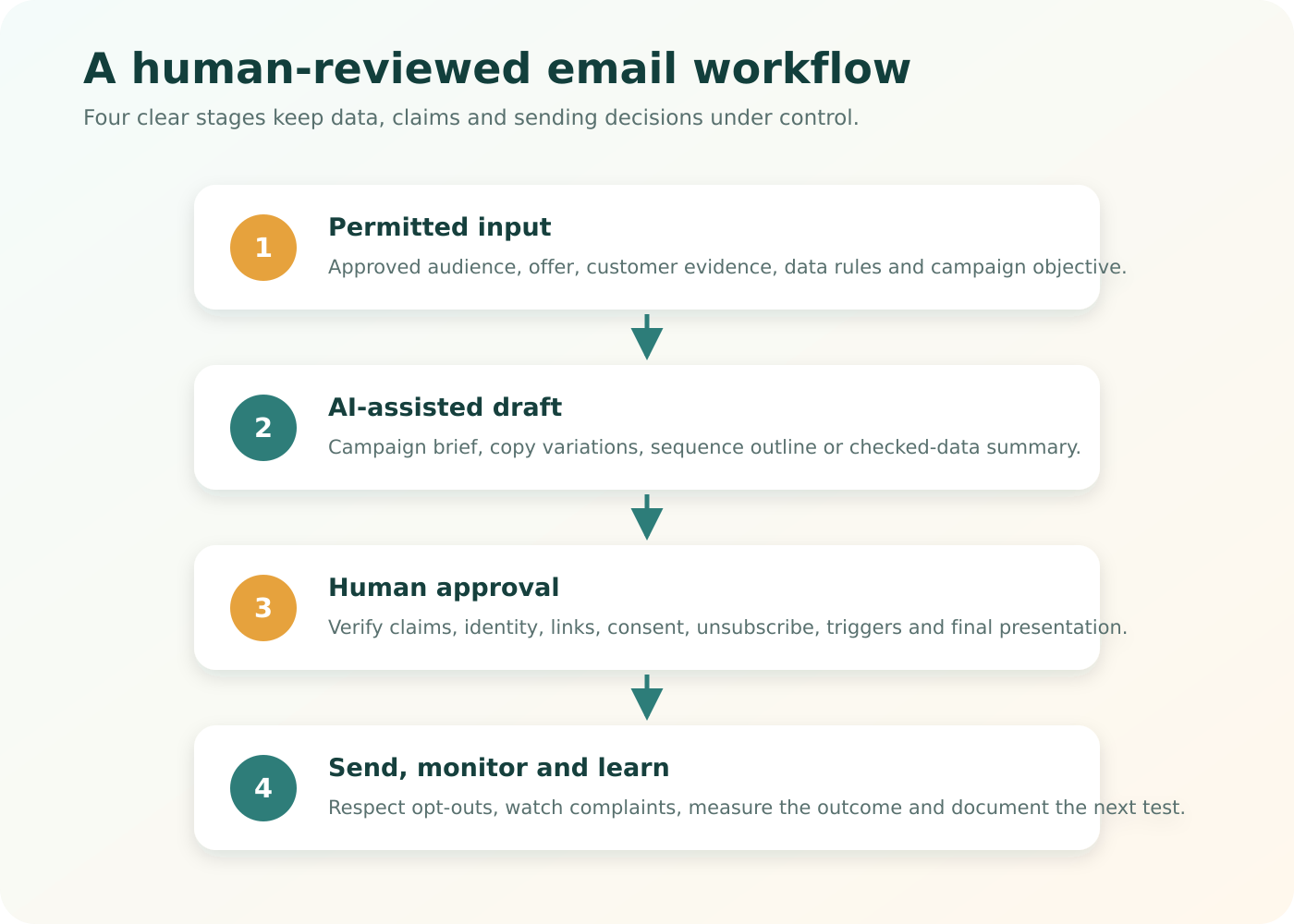
The store wants new subscribers to explore its handmade storage collection. Its approved evidence includes common questions about size, materials and delivery. Therefore, the campaign focuses on choosing the right storage piece instead of using an immediate discount.
AI groups the questions and creates a brief. However, the owner adds the real material details and delivery limits. The final sequence contains three messages: a buying guide, a room-size checklist and a customer-care invitation.
The reviewed workflow
First, the owner tests every link and removes an invented “sustainable” claim. Next, the email platform sends only to people who selected marketing updates. A reply, purchase or unsubscribe stops the sequence where appropriate.
After two weeks, AI summarizes the checked export. The owner reviews click, product-view, purchase, unsubscribe and complaint data. As a result, the next test changes one CTA while keeping the audience and offer consistent.
AI email marketing metrics worth reviewing
| Metric | Question it helps answer |
|---|---|
| Delivery rate | Did accepted messages reach receiving mail systems? |
| Click rate | Did recipients act on a link in the email? |
| Conversion rate | Did recipients complete the defined business action? |
| Unsubscribe rate | Did the campaign cause recipients to leave the list? |
| Spam-complaint rate | Did recipients report the message as unwanted? |
| Revenue or qualified leads | Did the campaign contribute to a valuable outcome? |
Do not let AI rename missing data or fill gaps with estimates. Instead, mark the value unavailable and improve tracking before the next campaign. You can also compare planning options with the Artsians marketing calculators and content tools.
Common AI email marketing mistakes to avoid
- Using vague prompts: generic instructions produce generic emails.
- Uploading customer records: only use approved data and minimum necessary fields.
- Inventing personalization: never assume private facts about a recipient.
- Automating before testing: confirm triggers, branches and stop rules first.
- Hiding the sender: identity and reply details must remain clear.
- Using deceptive urgency: deadlines and scarcity must be real.
- Ignoring unsubscribes: suppression must work across the sending process.
- Testing many changes together: isolate a useful variable whenever practical.
- Trusting summaries blindly: check calculations and campaign context.
Final AI email marketing checklist
| Area | Required review |
|---|---|
| Audience | Permission, recipient type, location and suppression status confirmed. |
| Data | Only permitted, necessary and appropriately protected information used. |
| Copy | Subject, claims, offer, price, deadline, links and CTA verified. |
| Identity | Sender, reply address and business details are clear and accurate. |
| Opt-out | Unsubscribe method is visible, simple and tested. |
| Automation | Trigger, timing, branches, stop rules and fallback checked. |
| Deliverability | Authentication, sending practices and spam monitoring reviewed. |
| Measurement | Hypothesis, primary metric, dates and next review recorded. |
Businesses comparing software can also review the Artsians guide to AI marketing tools for small businesses. Choose a tool only after defining the workflow and data rules.
AI email marketing frequently asked questions
Writing and personalization
How can a small business use AI for email marketing?
A small business can use AI to organize campaign ideas, prepare drafts, create approved variations, structure sequences and summarize checked results. Start with one campaign and use only permitted data. A person should still verify the offer, audience, links, consent, brand voice and final send settings.
Can AI write complete marketing emails?
AI can create a useful first draft when it receives a detailed brief. However, the business must check facts, prices, availability, claims, links, tone and legal requirements. Treat the output as editable copy rather than a message that is ready to send automatically.
Is AI email personalization safe?
It can be safer when the business uses approved fields, minimizes personal data and reviews the AI provider’s data practices. Do not paste private customer records into an unapproved public tool. Use aggregated, fictional or de-identified inputs for drafting whenever individual data is unnecessary.
Can AI improve email subject lines?
AI can produce subject-line variations based on a verified offer and audience. A reviewer should remove deceptive urgency, unsupported claims and wording that does not match the email. Test one meaningful variable at a time, then judge the result with a defined metric.
Automation, measurement and compliance
Which email metrics should AI analyze?
Provide checked delivery, click, conversion, unsubscribe and spam-complaint data with dates and definitions. AI can summarize patterns and propose questions. Still, a person should check calculations, sample size, campaign differences and whether any change can truly be linked to the tested variable.
Can AI send marketing emails automatically?
Some platforms can combine AI features with automation, but unattended sending adds risk. First approve the audience rules, trigger, content, suppression list, unsubscribe process and stop conditions. Test with internal addresses before activating a live sequence, and keep an authorized person responsible for monitoring it.
Do AI marketing emails still need an unsubscribe option?
Using AI does not remove email-marketing obligations. Requirements depend on the recipient, country and message type. For example, official UK and US guidance includes clear identity and opt-out requirements for covered marketing emails. Check the rules for every market and sending situation.
What information should not be entered into an AI email tool?
Avoid passwords, payment details, private contracts, health information, confidential business records and identifiable customer data unless the tool and use have been formally approved. Share only the minimum information needed, and replace real names or addresses with safe placeholders during drafting.
Use AI for email marketing to support better decisions
Start with a permitted audience and one clear objective. Then use AI to organize evidence, prepare drafts and suggest useful tests. However, keep people responsible for data, claims, consent, sender setup and final approval. As a result, the business gains speed without giving up accountability.
Comments